The Stars (1979-1983), the self-taught group that revolutionized art in China
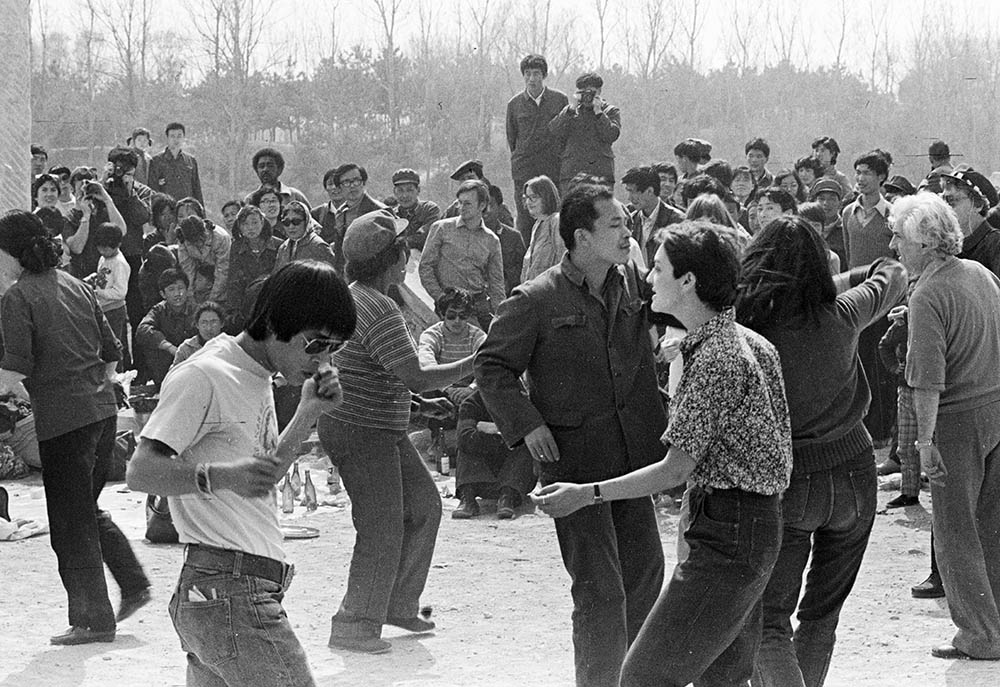
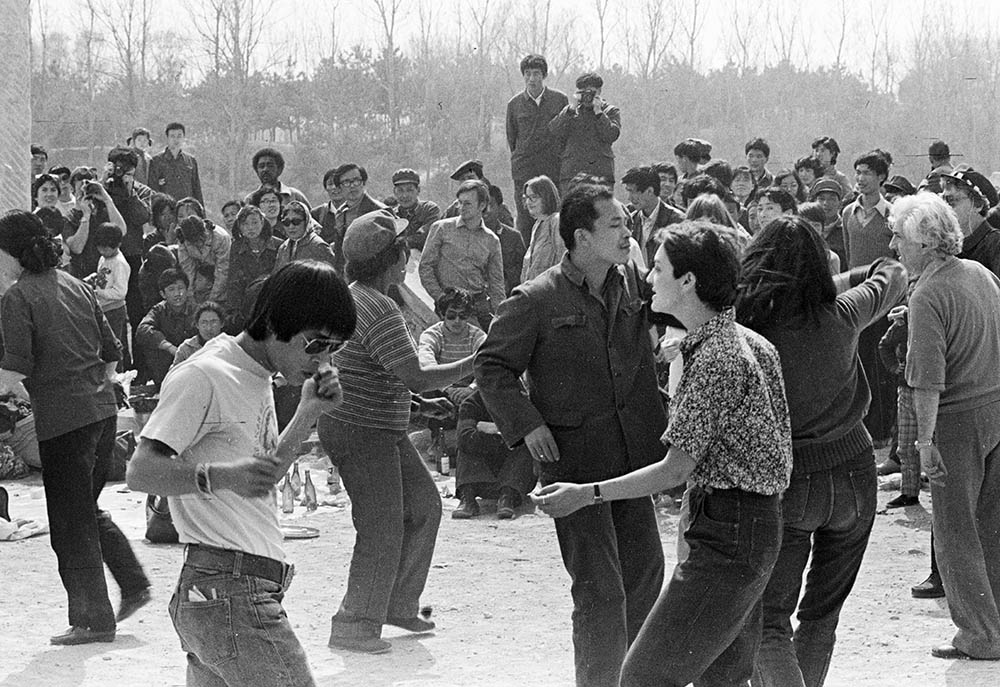
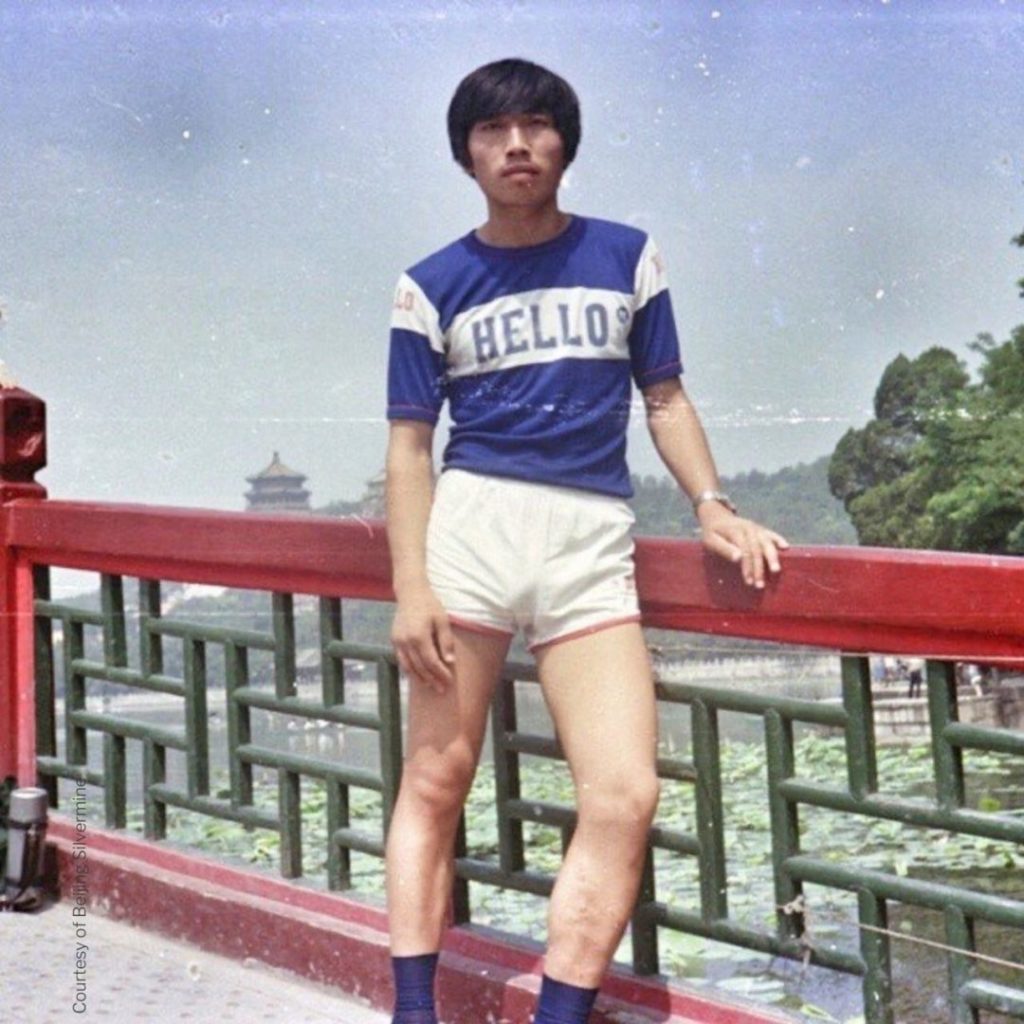
Li Xiaobin, Party organized by the Stars at the Old Summer Palace (Yuanmingyuan), 1980
To mark the opening of a permanent exhibition space dedicated to the Chinese Star Movement at the Centre Pompidou on December 3, 2024, we wanted to revisit the exhibition “The Stars, 1979-2019, Pioneers of Contemporary Art in China” which Doors devoted in 2019 to this group of revolutionary pro-democracy artists, the first Chinese contemporary art movement, active between 1979 and 1983. We have designed this article as a virtual tour of the exhibition, a way to experience it—or re-experience it—in the chronological order imagined a few years ago.
The exhibition was held at the premises of the travel agency Les Maisons du Voyage, formerly La Maison de la Chine, founded in 1991 as the first French travel agency specializing in trips to China.
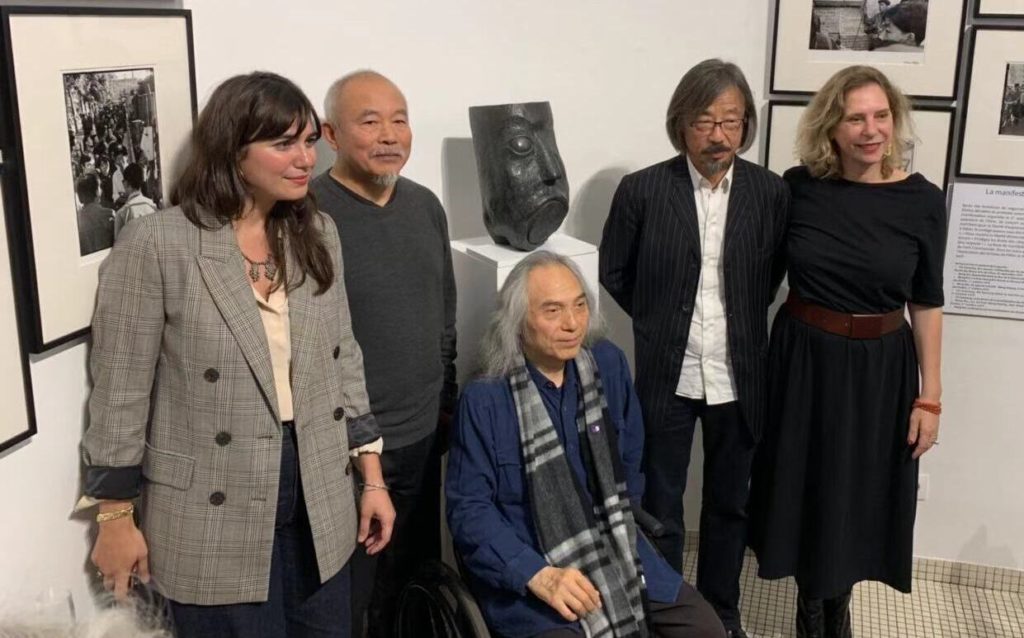
Curated by Bérénice Angremy and Victoria Jonathan, the two co-founders of Doors 门艺, the exhibition brought together works by three of its leading figures: Huang Rui, Ma Desheng, and Wang Keping, as well as previously unseen photographs by three privileged witnesses of this era: Chi Xiaoning, Li Xiaobin, and Wang Rui.
From left to right : Victoria Jonathan, Wang Keping, Ma Desheng, Huang Rui, Bérénice Angrémy
I. The Beijing Spring, the Democracy Wall, and the political context at the turn of the 1970s
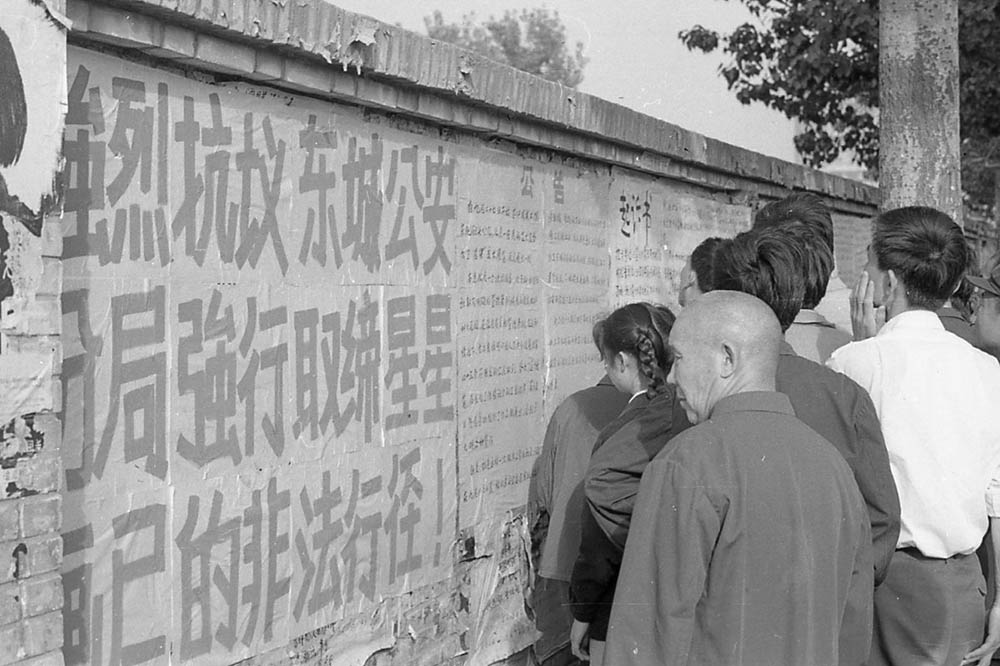
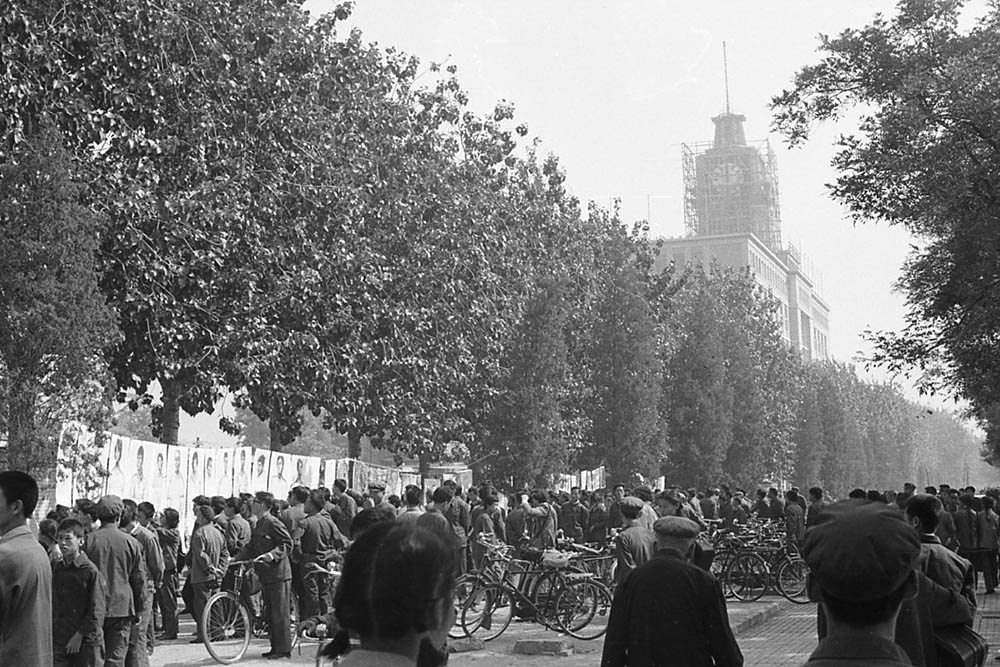
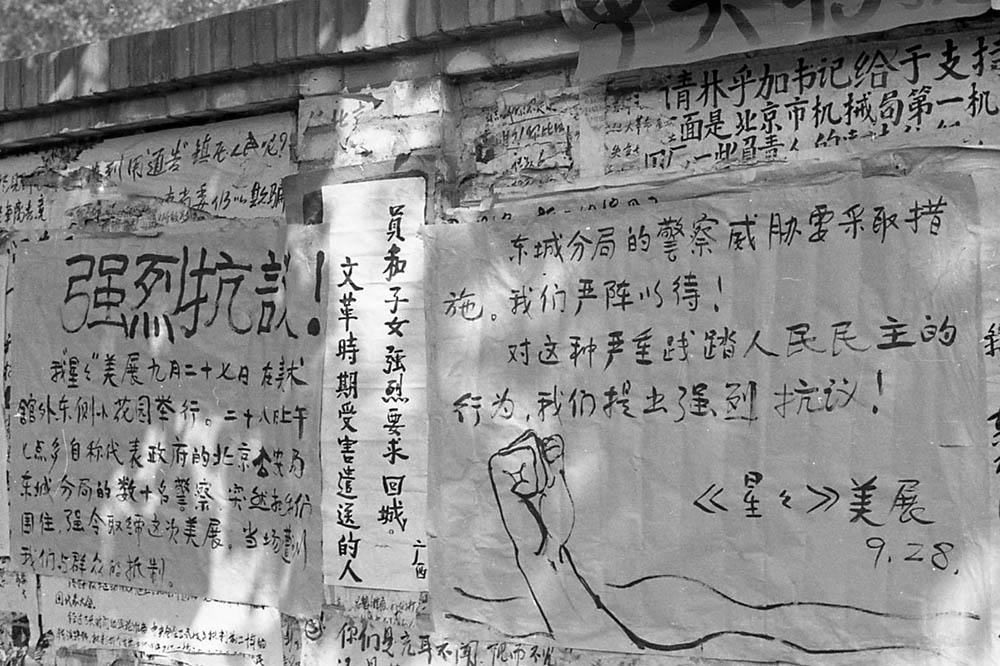
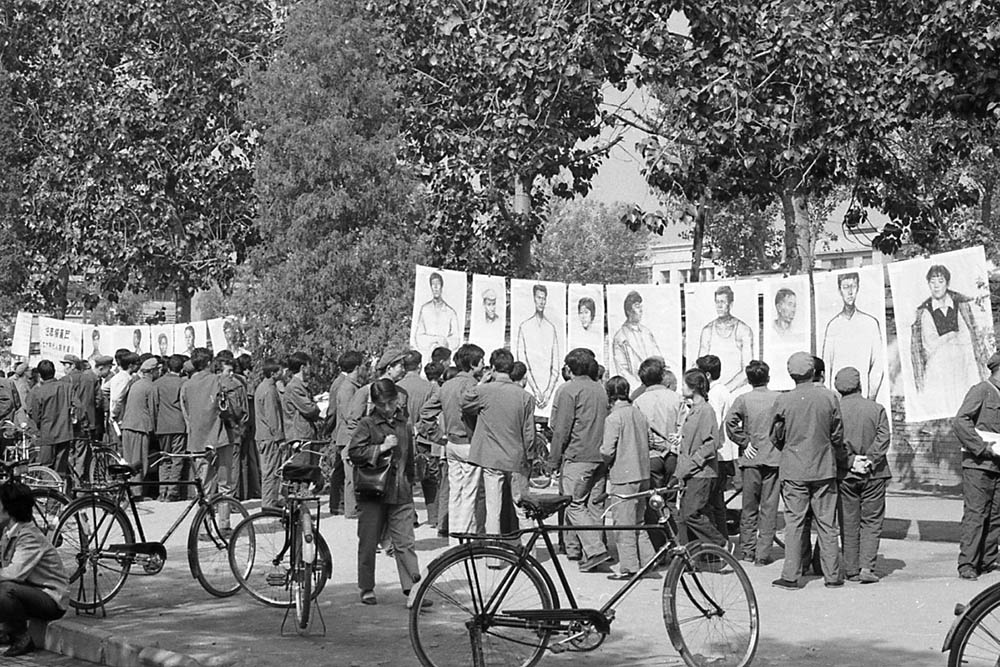
When economic reforms were announced at the end of 1978, the country was swept up in a wave of euphoria. Having just emerged from the Cultural Revolution, China put the Gang of Four on trial and reassessed this dark period in its history. Deng Xiaoping returned to power, seeking to transform the country through the “Four Modernizations” and initially encouraging citizen expression. Across the country, dazibao (posters) covered with texts written by citizens were plastered on the streets, becoming a forum for public debate. In Beijing, on Xidan Avenue, one of these dazibao walls, renamed the “Democracy Wall” was erected, where thousands of people expressed themselves every day and exchanged ideas, independent publications, poems, and works of art. The movement, with leaders such as Wei Jingsheng, was suppressed at the end of 1979.
Wang Rui, Dazibao at the Democracy Wall in Xidan (Beijing), September 1979
Wang Rui, The Democracy Wall on Xidan Avenue (Beijing), September 1979
Li Xiaobin, Dazibao written by the Stars and underground magazines on the Democracy Wall in Xidan (Beijing), 1979
Wang Rui, Dazibao at the Democracy Wall in Xidan (Beijing), September 1979
Wang Rui, The Democracy Wall on Xidan Avenue (Beijing), September 1979
Li Xiaobin, Dazibao written by the Stars and underground magazines on the Democracy Wall in Xidan (Beijing), 1979
II. The late 1970s: An artistic and literary renaissance
China was emerging from a long period of isolation and prohibition of all non-political artistic expression. As early as 1942, in his Yanan speech, Mao had asserted that art and literature should serve the people and the revolution. This principle was emphasized during the Cultural Revolution, a period during which his wife Jiang Qing, a former actress, defined a number of “model works” to be propagated throughout the country. Artists and intellectuals were regimented and even persecuted, their works banned and sometimes even destroyed. It was not until the late 1970s that creative voices began to be heard again and artistic groups began to form, such as the Stars, the No Name Group, the Spring Tide Group (Oil Painting Research Association), the April Photography Society, and the Enlightenment Society (Guizhou). Literary movements emerged, such as Scars and Blurred Poetry. At the Democracy Wall, manifestos and poems were published, and literary magazines were distributed, including Jintian (Today), co-founded by poets Bei Dao, Mang Ke, and a future member of the Stars, Huang Rui.
Wang Rui, Works exhibited at the Democracy Wall on Xidan Avenue (Beijing), September 1979
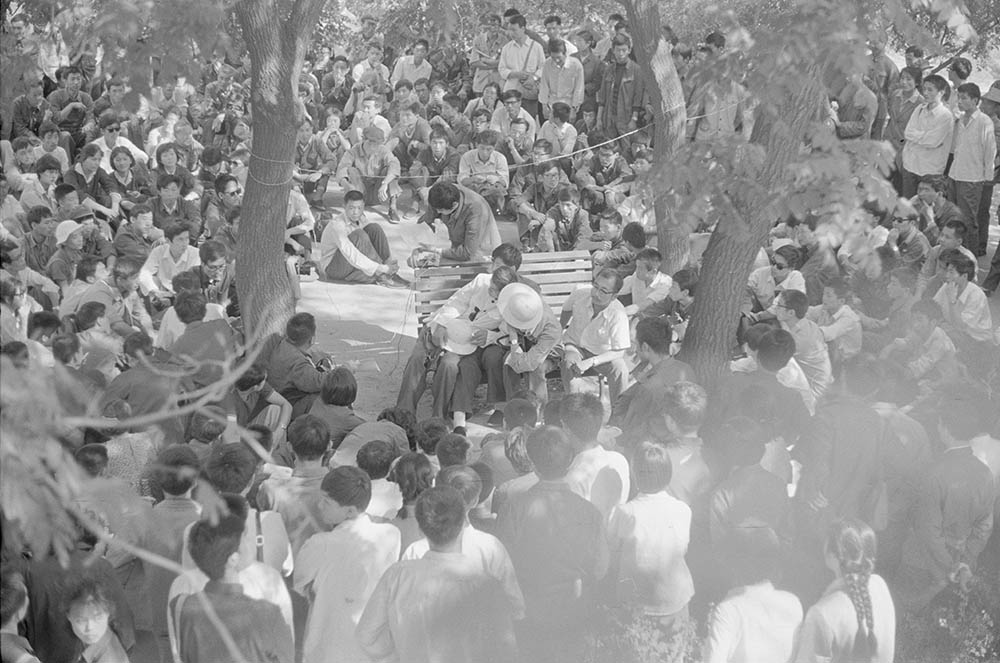
Chi Xiaoning, First public poetry reading organized by the poet Mang Ke and his magazine “Today”, 1979.
Wang Rui, Works exhibited at the Democracy Wall on Xidan Avenue (Beijing), September 1979
Chi Xiaoning, First public poetry reading organized by the poet Mang Ke and his magazine “Today”, 1979.
III. September 1979: The first exhibition of the Stars
Inspired by the prevailing winds of freedom, Huang Rui and Ma Desheng decided to organize an exhibition at the end of September at the National Art Museum of China, where the 5th National Art Exhibition was to take place. Founded by Mao in 1958, the Art Museum represented the most official form of art. However, in a sign of the times, in 1978 it hosted its first foreign exhibition, “Landscape Painting in France in the 19th Century,” featuring works by Courbet, Corot, Millet, Pissarro, and others. Encouraged by this sign of openness, Huang Rui and Ma Desheng submitted a request to the Beijing Artists Association to hold a contemporary art exhibition in the museum’s galleries and began collecting works by independent artists. When their request was denied, they announced that the exhibition would take place outside the museum, with no reaction from the authorities.
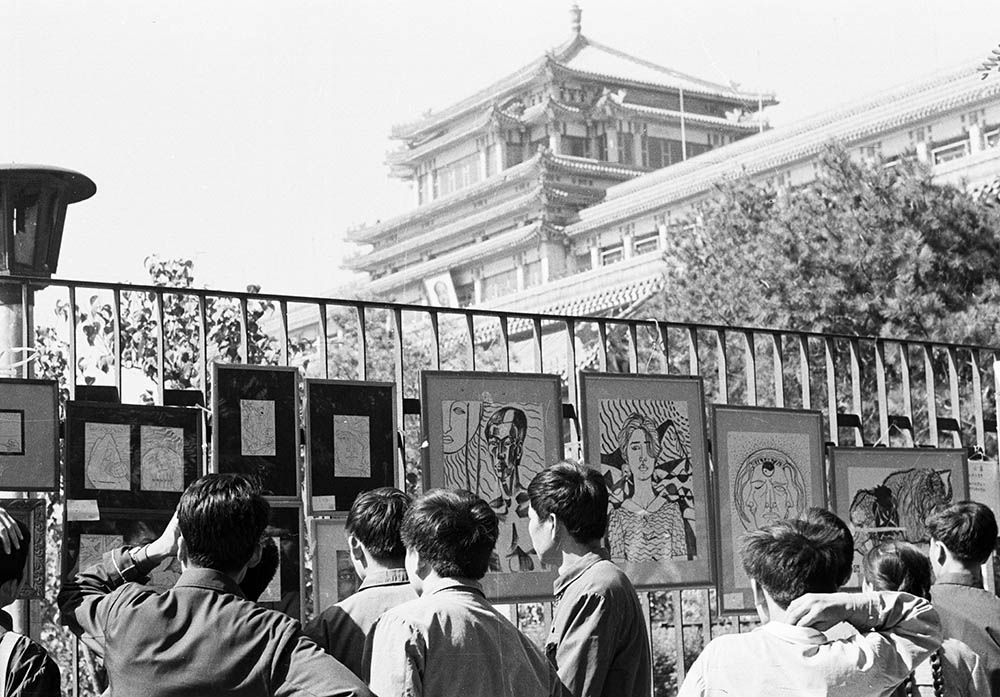
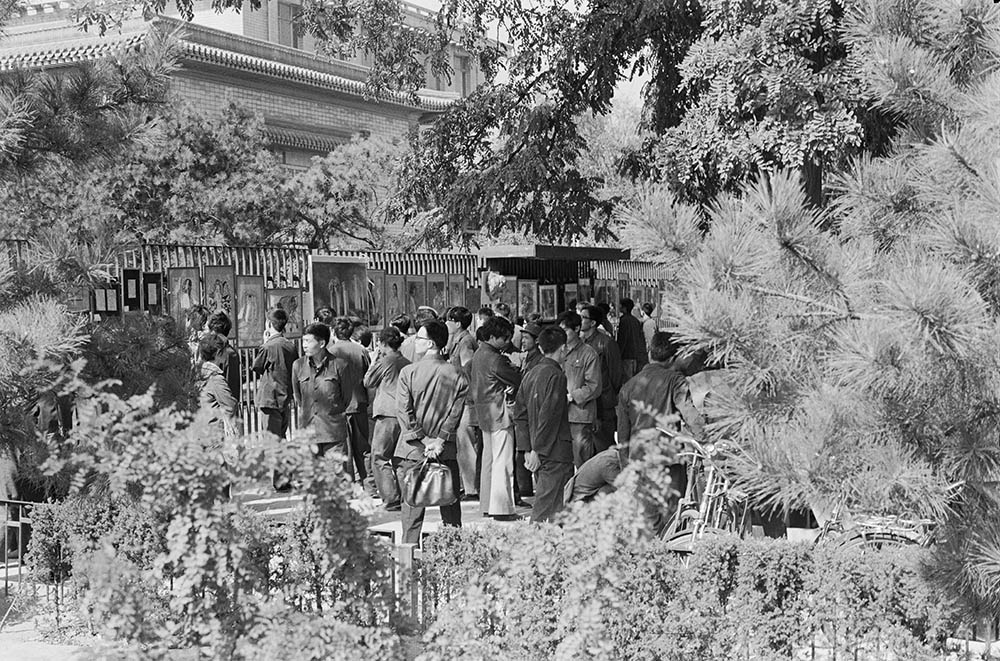
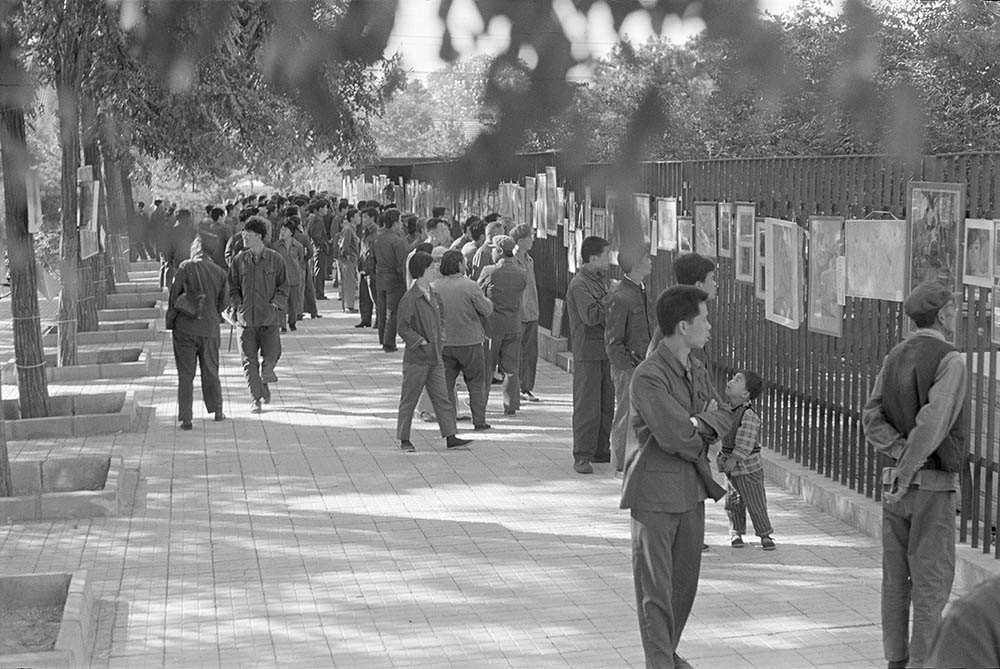
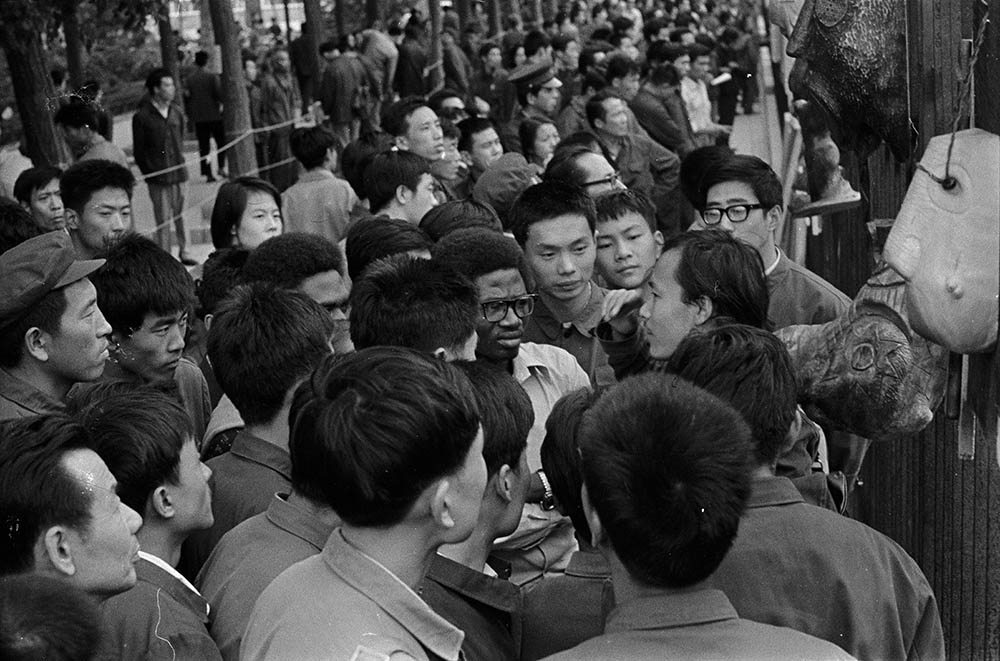
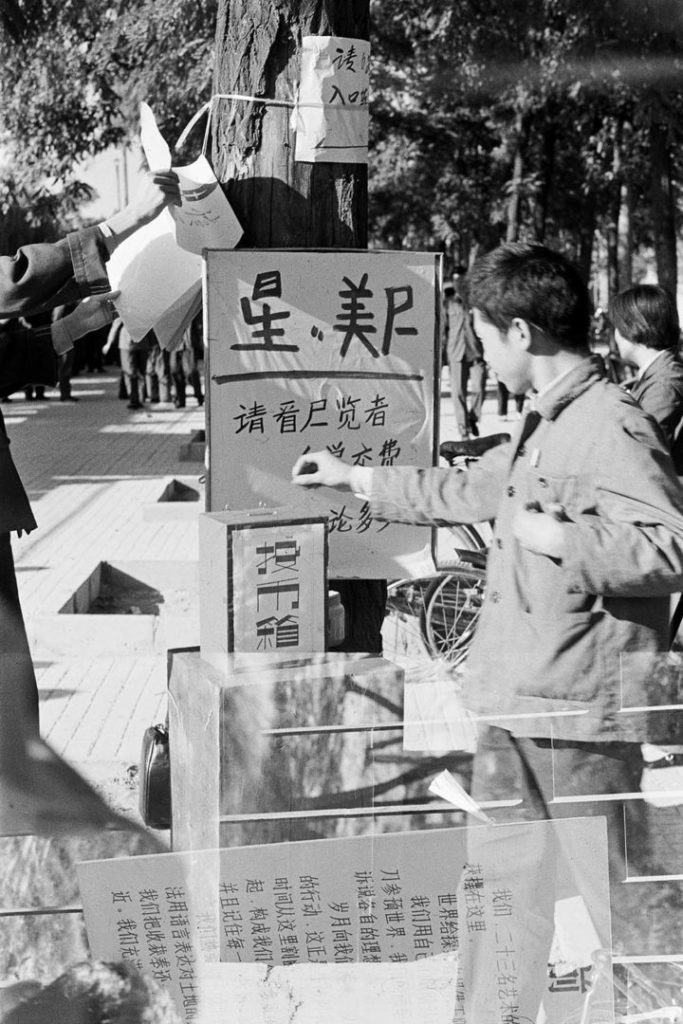
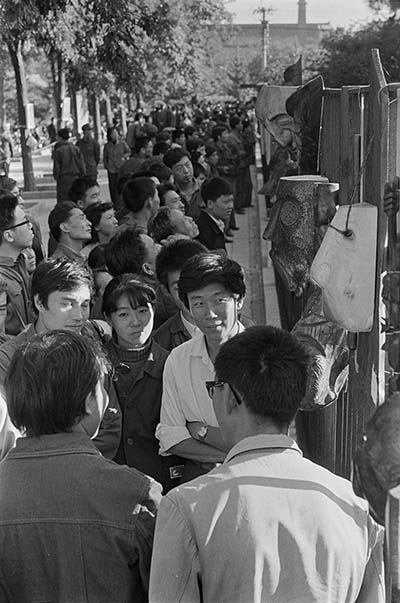
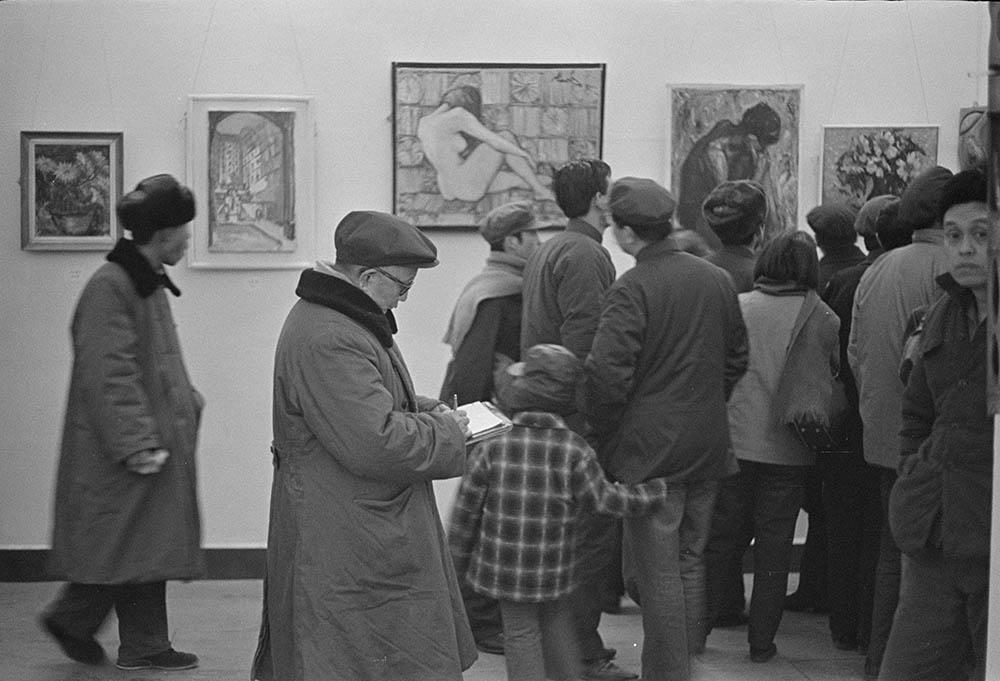
On the morning of September 27, 150 works by 23 artists were hung on the railings of the National Art Museum of China, stretching for around 40 meters. Paintings, drawings, sculptures, engravings; portraits, landscapes, political satire, and even nudity; figurative art, abstract art, inspiration from modern Western art, reinterpretations of Chinese traditions… The exhibition showcased the diversity of languages, themes, and techniques being explored by this new generation of artists, most of whom were self-taught. On the first day, the exhibition attracted 25,000 visitors, including government officials. The artists engaged in discussions with the public and encouraged visitors to express themselves, notably through notebooks attached to the trees facing the gates. On September 29, the exhibition was banned by the authorities and the works of art confiscated.
Li Xiaobin, Drawings by Qu Leilei hung on the railings of the Fine Arts Museum of China, 1st Stars exhibition, September 1979
Li Xiaobin, Works hung on the railings of the Fine Arts Museum of China,1st Stars exhibition, September 27, 1979
Chi Xiaoning, Visitors on the opening day of the 1st Stars exhibition, September 27, 1979
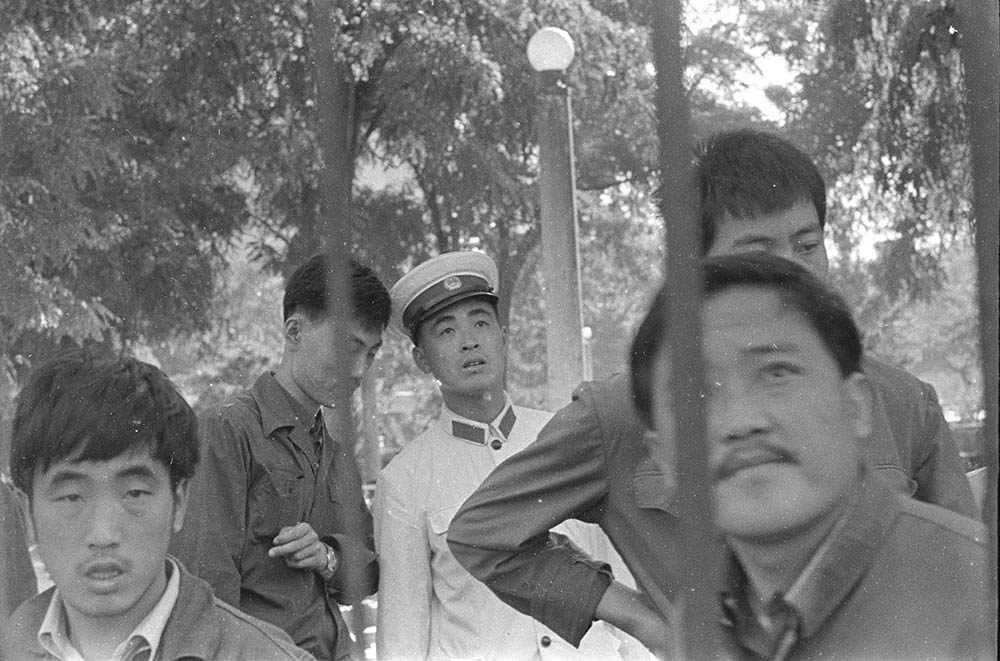
Chi Xiaoning, Visitors and police officer at the 1st Stars exhibition, September 28, 1979. From the second day of the exhibition, police officers were on hand to monitor the show.
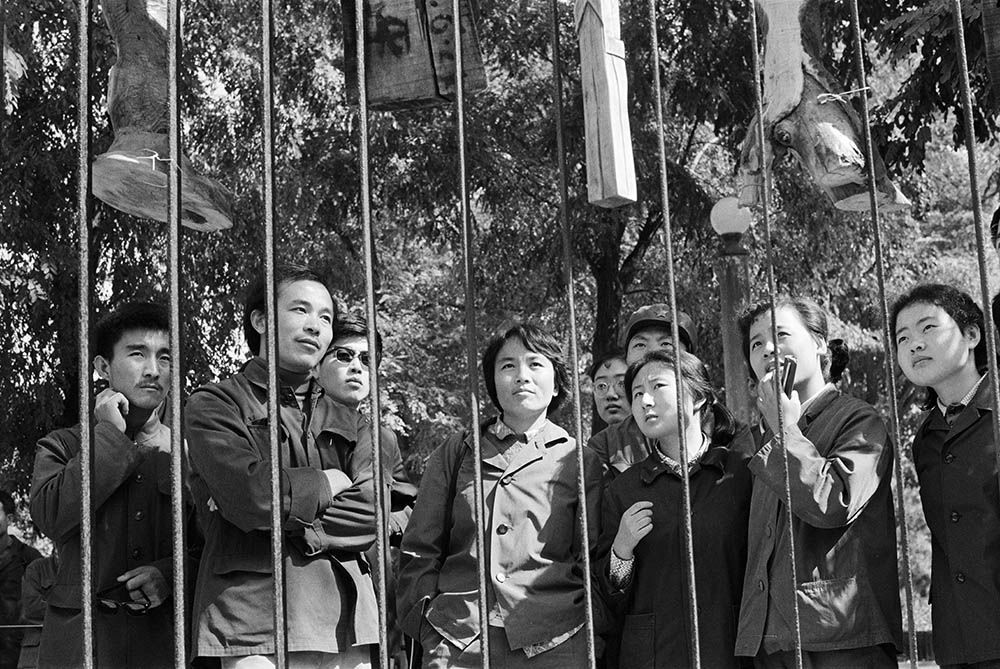
Li Xiaobin, Wang Keping and visitors in front of his sculptures, 1st Stars exhibition, September 1979
Chi Xiaoning, Wang Keping presents his sculptures to visitors at the 1st Stars exhibition, September 1979
Li Xiaobin, Visitors make donations in a piggy bank to benefit the 1st Stars exhibition, September 1979
Li Xiaobin, Artists Yan Li, Li Shuang and Qu Leilei converse with visitors in front of works by Wang Keping (including Silence) at the 1st Stars exhibition, September 1979
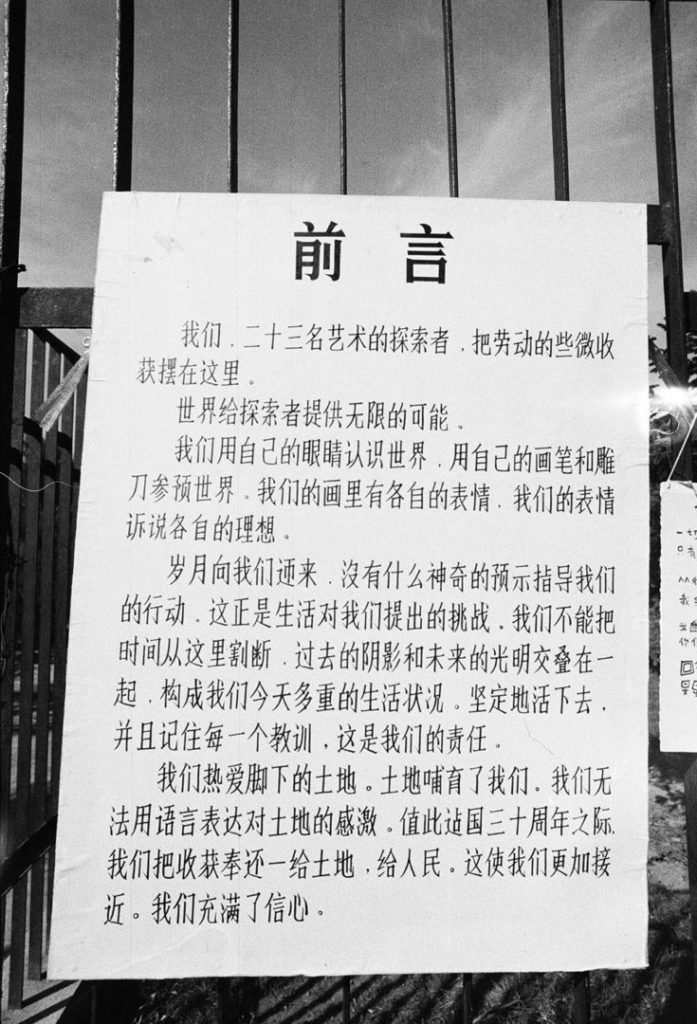
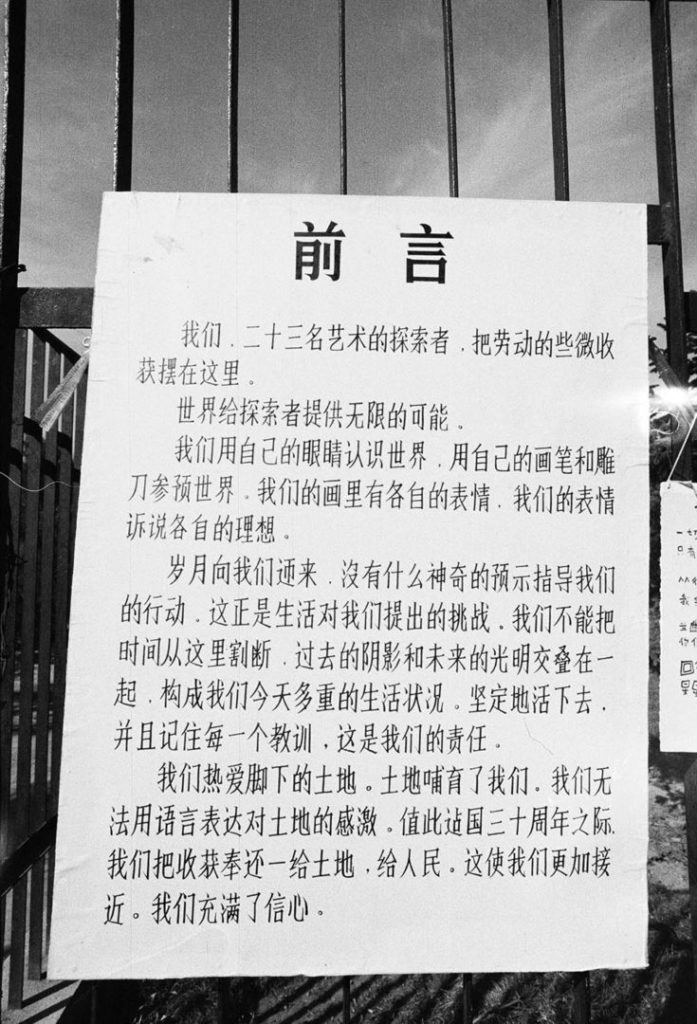
Li Xiaobin, Introduction to the 1st Stars exhibition hung on the gates of the National Fine Arts Museum of China, September 27, 1979.
Li Xiaobin, Drawings by Qu Leilei hung on the railings of the Fine Arts Museum of China, 1st Stars exhibition, September 1979
Li Xiaobin, Works hung on the railings of the Fine Arts Museum of China,1st Stars exhibition, September 27, 1979
Chi Xiaoning, Visitors on the opening day of the 1st Stars exhibition, September 27, 1979
Chi Xiaoning, Visitors and police officer at the 1st Stars exhibition, September 28, 1979. From the second day of the exhibition, police officers were on hand to monitor the show.
Li Xiaobin, Wang Keping and visitors in front of his sculptures, 1st Stars exhibition, September 1979
Chi Xiaoning, Wang Keping presents his sculptures to visitors at the 1st Stars exhibition, September 1979
Li Xiaobin, Visitors make donations in a piggy bank to benefit the 1st Stars exhibition, September 1979
Li Xiaobin, Artists Yan Li, Li Shuang and Qu Leilei converse with visitors in front of works by Wang Keping (including Silence) at the 1st Stars exhibition, September 1979
Li Xiaobin, Introduction to the 1st Stars exhibition hung on the gates of the National Fine Arts Museum of China, September 27, 1979.
Introductory text for the Stars exhibition, September 1979:
“We, twenty-three artist-researchers, are exhibiting some of the results of our work. The world offers researchers unlimited possibilities. We use our own eyes to learn about the world, and we participate in it with our brushes and scissors. Our paintings contain all kinds of expressions, reflecting the ideals of each of us.
Time comes to meet us; no magical prediction dictates our actions; it is the only life that challenges us. We cannot stop time in the present moment; the shadows of the past and the lights of the future are accumulated together and form our multifaceted environment. To continue living resolutely, to retain every lesson, such are our responsibilities.
We deeply love the soil beneath our feet. The earth has nourished us. We have no way to express our gratitude to it in words. We take advantage of the 30th anniversary of the People’s Republic of China to dedicate our harvests to the Earth and the People. This brings us closer together. We are filled with confidence.”
Li Xiaobin, Introduction to the 1st Stars exhibition hung on the gates of the National Fine Arts Museum of China, September 27, 1979.
IV. The demonstration of October 1, 1979
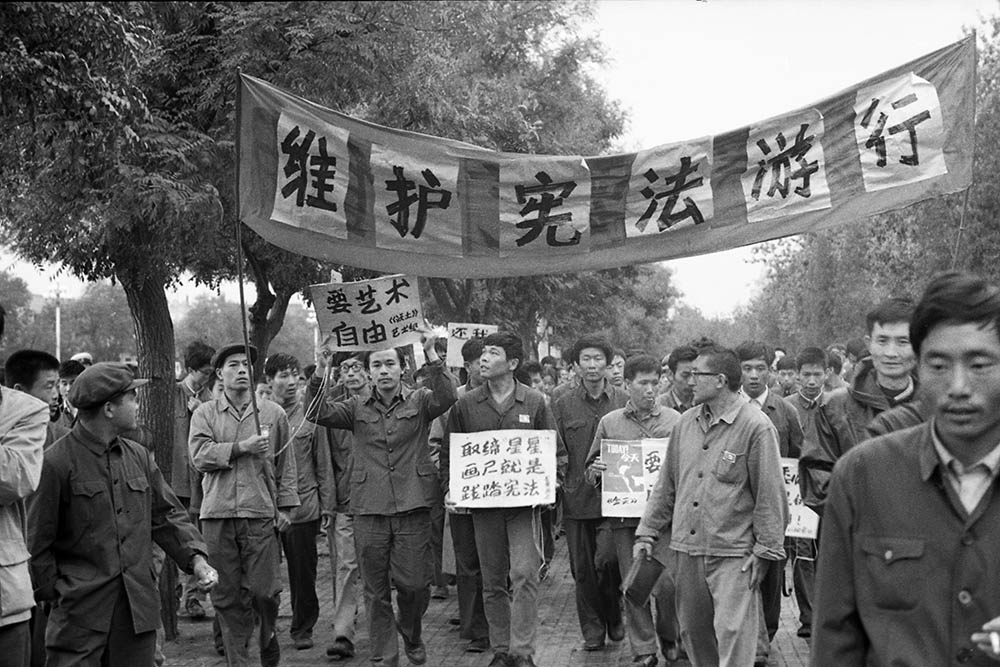
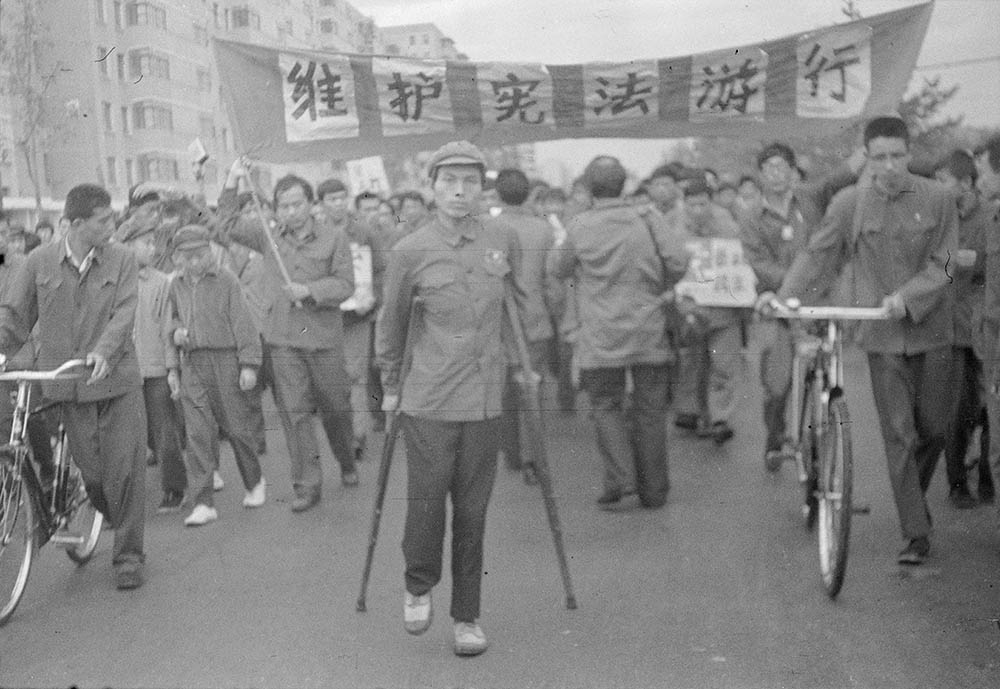
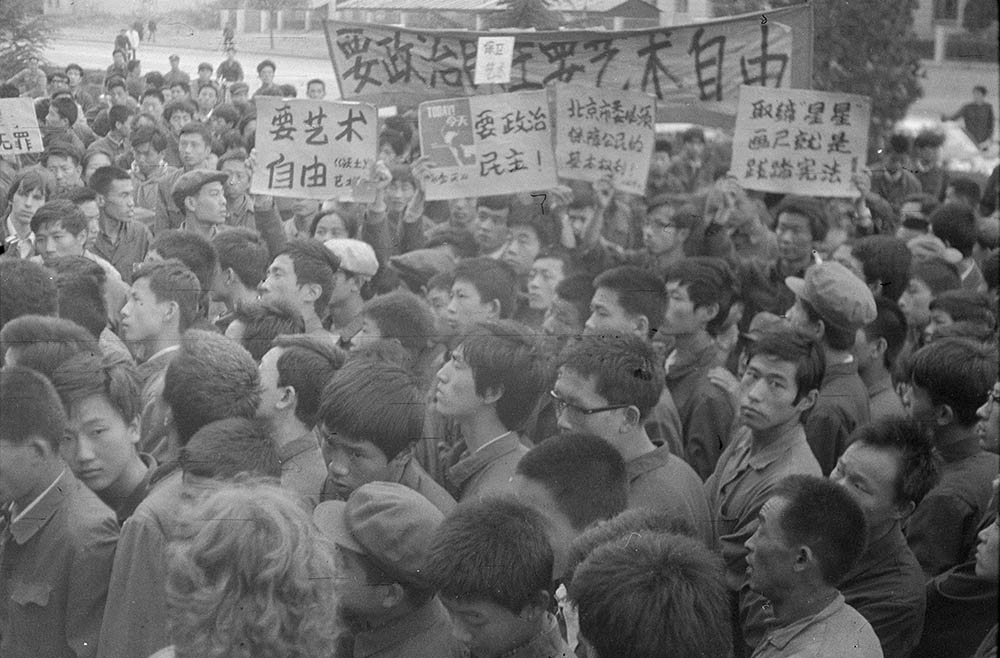
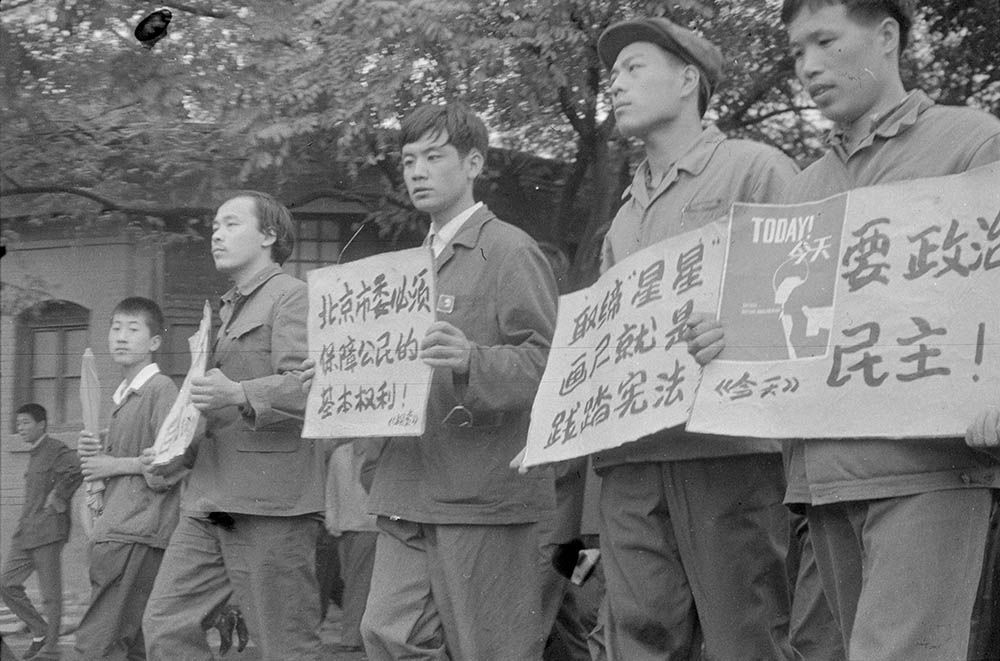
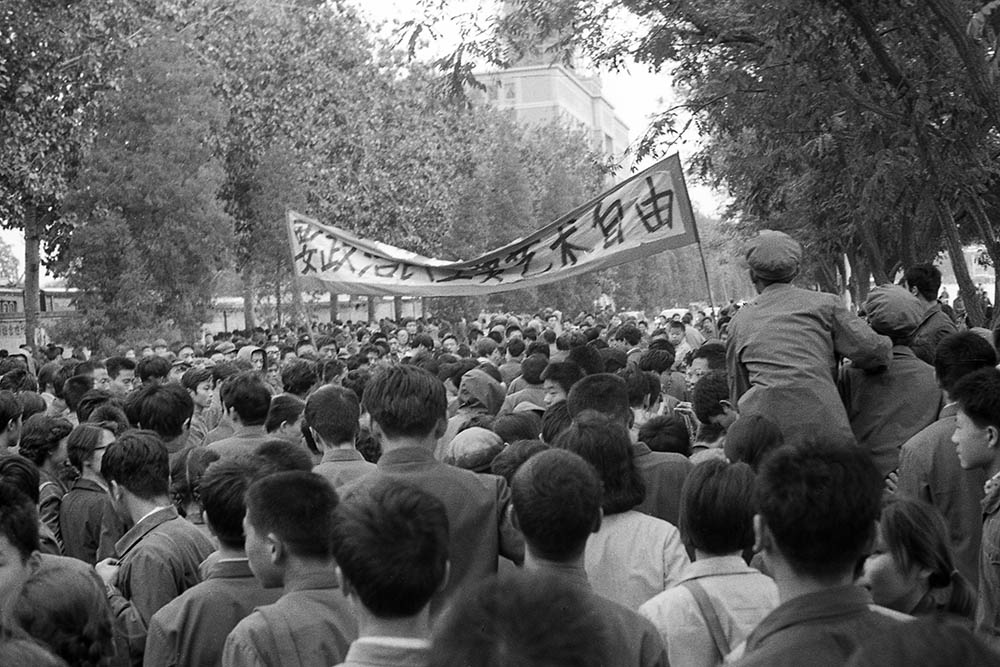
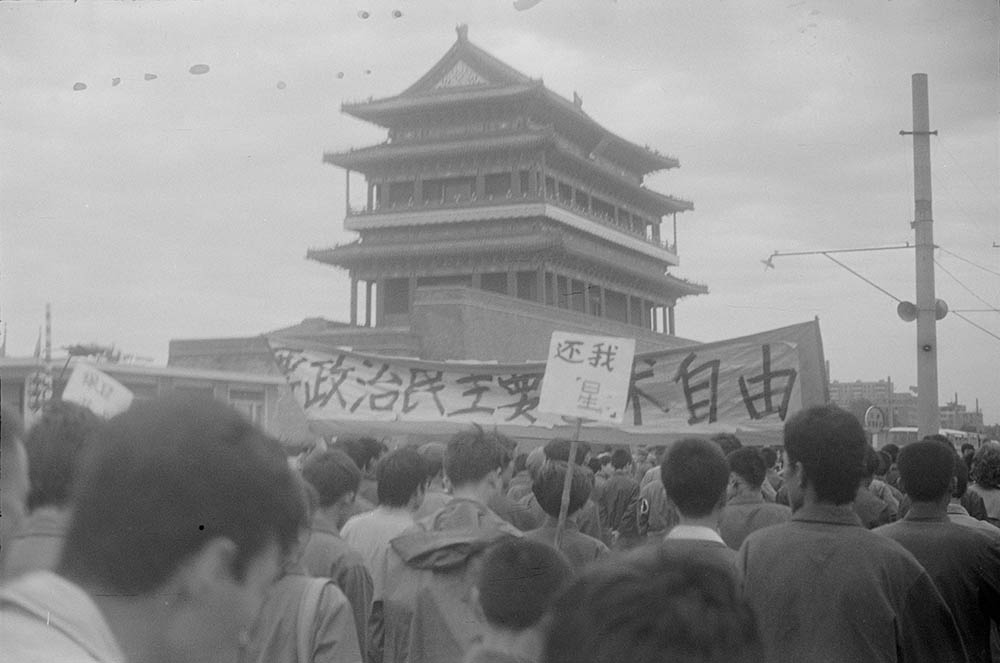
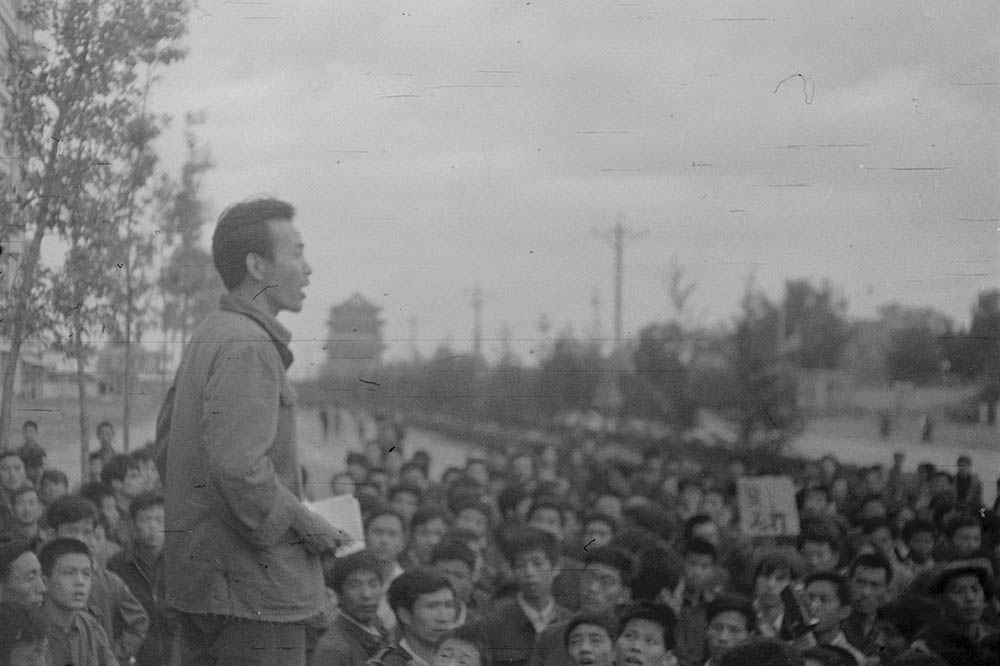
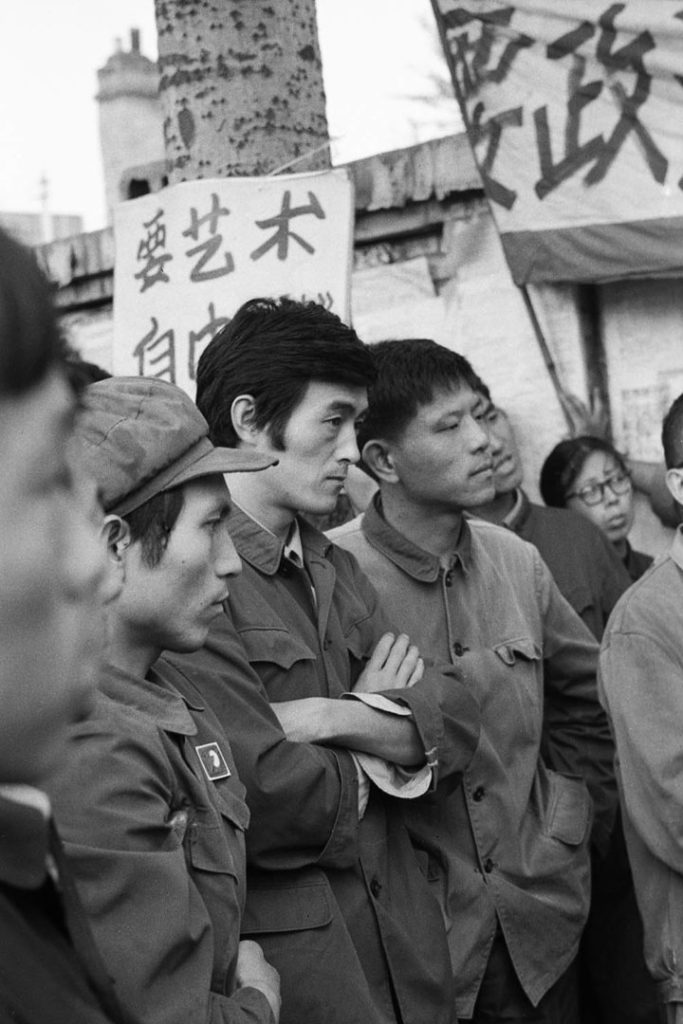
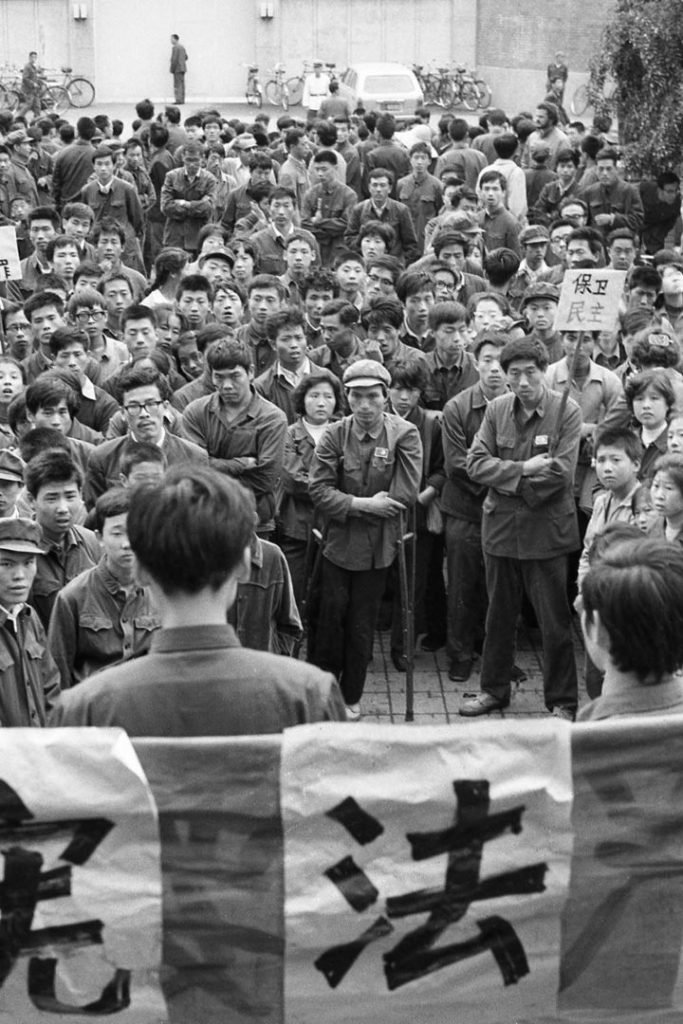
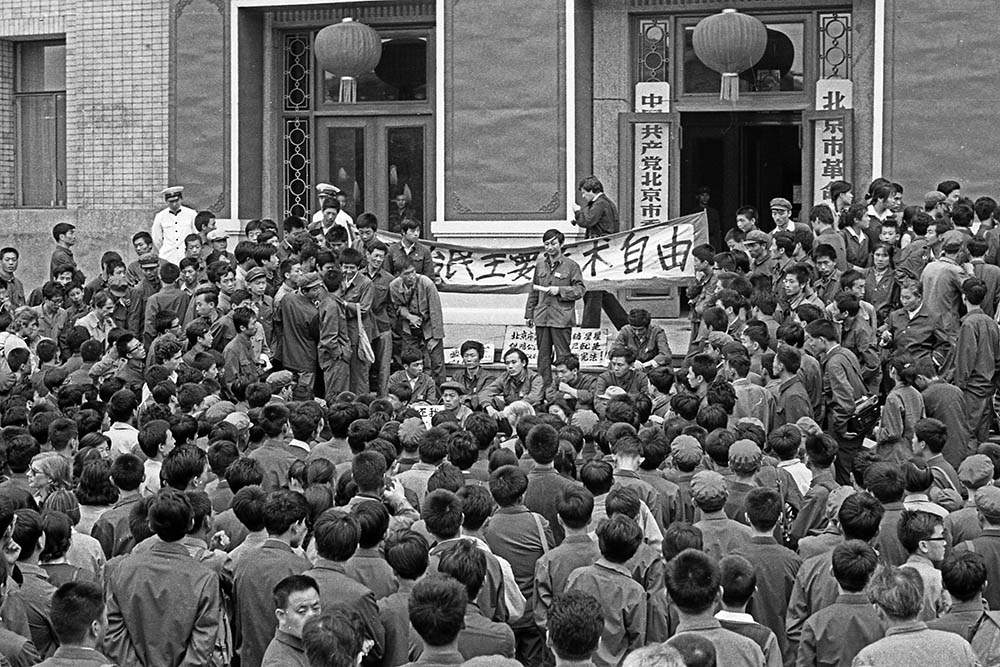
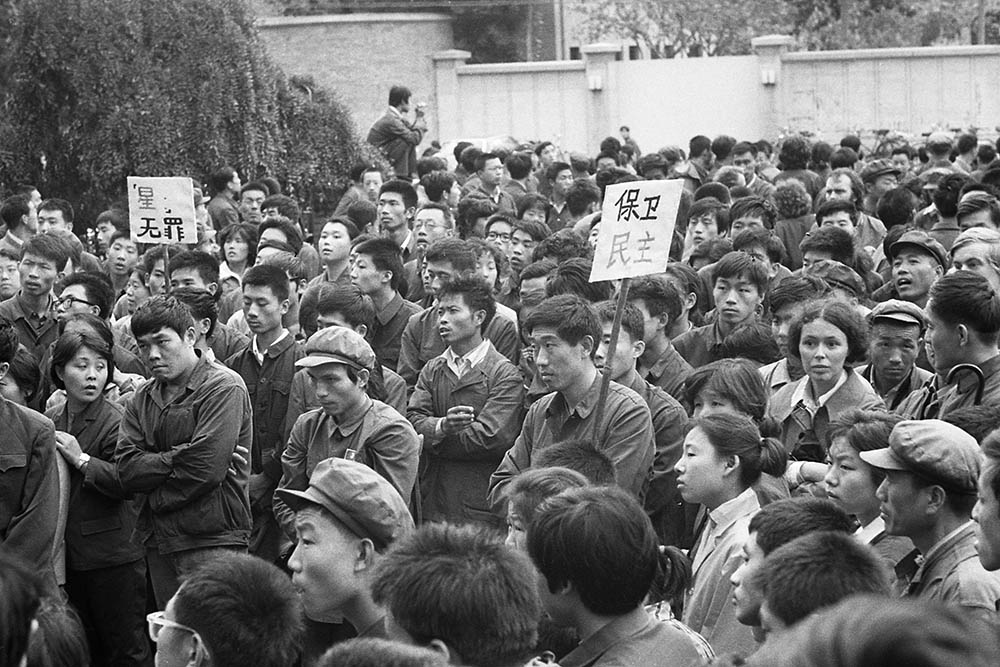
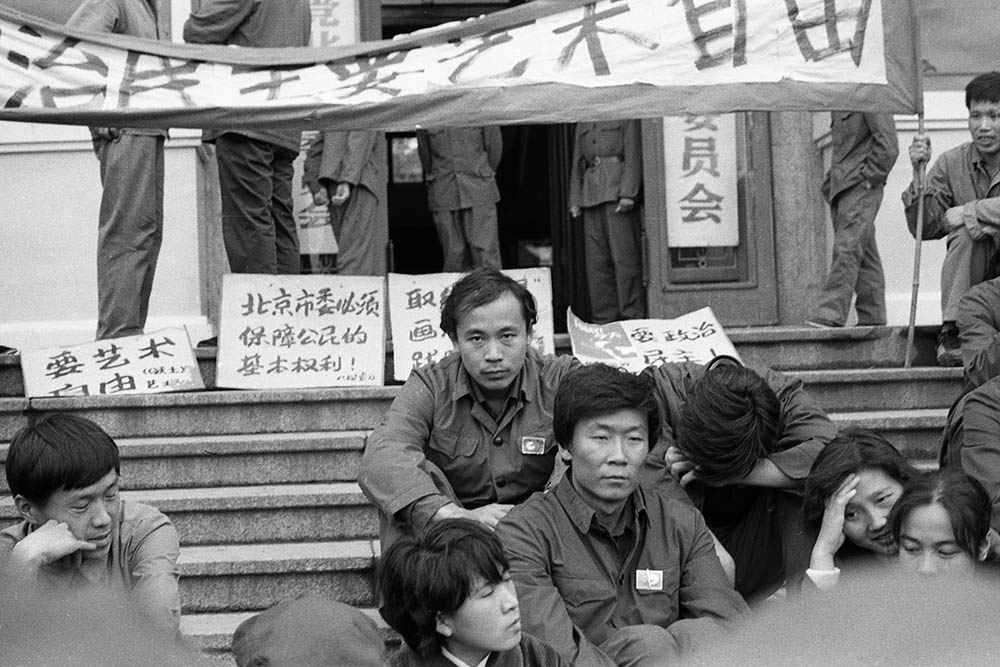
After attempting to negotiate with the authorities, having broken no laws, the Stars decided to protest against the arbitrary ban on their exhibition by organizing a demonstration on October 1. On this day, the 30th anniversary of the People’s Republic of China, together with actors from the Democracy Wall, the artists marched for freedom of expression and democracy. Starting from the Democracy Wall in Xidan, the procession marched under banners proclaiming “We want freedom of creation,” “We want democratic freedom,” “We protest to enforce the law,” and “Protect citizens’ rights! The right to organize cultural activities must be respected!” The crowd of demonstrators marched through the city center to the Municipal Committee of the Communist Party. In the days following the demonstration, the Stars obtained permission from the Beijing Artists Association to reopen their exhibition a few weeks later.
Wang Rui, Artists Wang Keping, Gan Shaocheng and Qu Leilei in the front row of the Stars demonstration, October 1, 1979
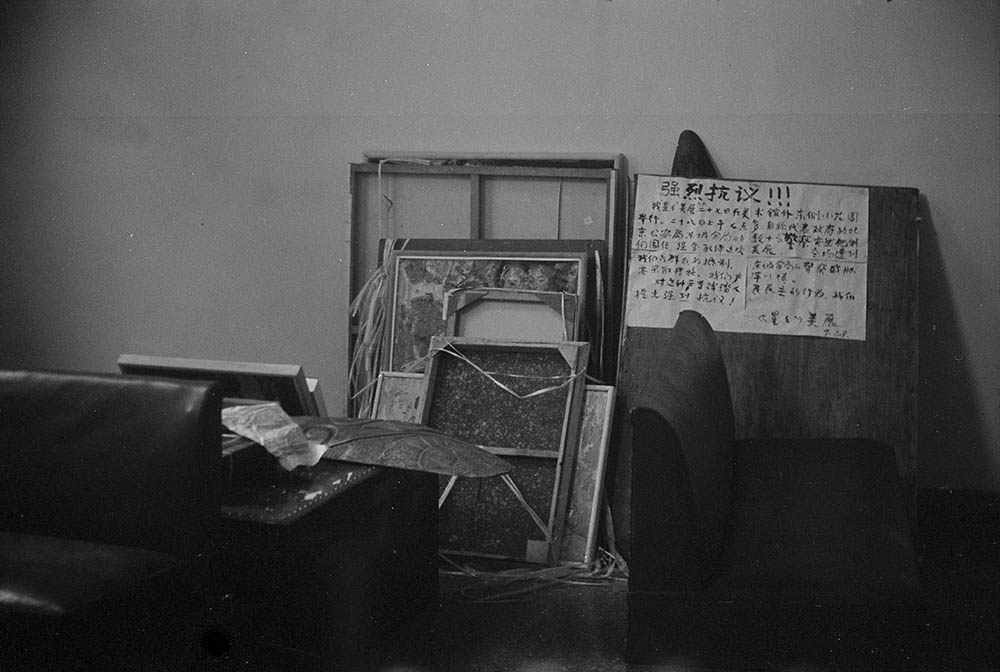
Chi Xiaoning, Works confiscated by the authorities following the banning of the exhibition are stored inside the China Fine Arts Museum, September 29, 1979
Chi Xiaoning, Ma Desheng leads the march on Xuanwumen Avenue during the Stars demonstration, October1, 1979
Chi Xiaoning, The crowd at the Stars demonstration, October 1, 1979
Wang Rui, From left to right: Wang Keping, E Fuming, Lu Lin and Liang Daguang in the front row of the Stars demonstration, October 1, 1979
Wang Rui, The crowd at the Stars demonstration, October 1, 1979
Chi Xiaoning, The Stars Demonstration at Zhengyangmen (Qianmen) Gate in Tiananmen Square, October 1, 1979
Chi Xiaoning, Artist Xu Wenli's speech to the demonstrators, October 1, 1979
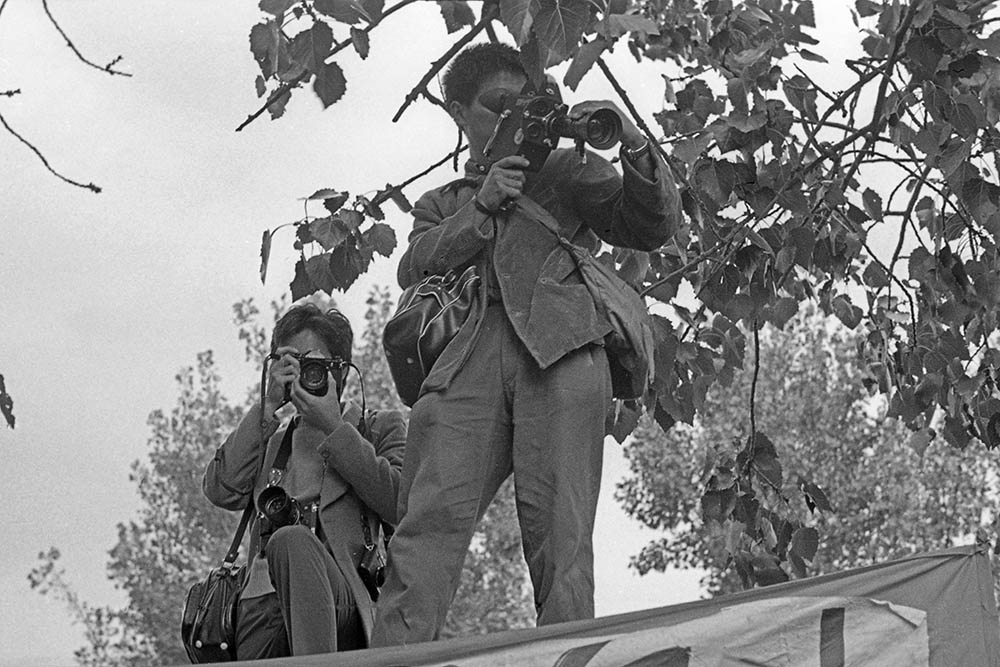
Wang Rui, Photographers Liu Heung Shing and Chi Xiaoning photograph and film the Stars demonstration, October 1, 1979
Wang Rui, Artist Ma Desheng and poet Mang Ke at the Stars demonstration, October 1, 1979
Wang Rui, Demonstrators in front of the Communist Party Municipal Committee building, October 1, 1979. In foreground: Ma Desheng.
Wang Rui, Speech in front of the Communist Party Municipal Committee building, October 1, 1979.
Wang Rui, Artist Liu Qing gives a speech to demonstrators gathered in front of the Communist Party Municipal Committee building, October 1, 1979.
Wang Rui, Artists Wang Keping and Qu Leilei seated on the steps of the Communist Party Municipal Committee building, October 1, 1979
Wang Rui, Artists Wang Keping, Gan Shaocheng and Qu Leilei in the front row of the Stars demonstration, October 1, 1979
Chi Xiaoning, Works confiscated by the authorities following the banning of the exhibition are stored inside the China Fine Arts Museum, September 29, 1979
Chi Xiaoning, Ma Desheng leads the march on Xuanwumen Avenue during the Stars demonstration, October1, 1979
Chi Xiaoning, The crowd at the Stars demonstration, October 1, 1979
Wang Rui, From left to right: Wang Keping, E Fuming, Lu Lin and Liang Daguang in the front row of the Stars demonstration, October 1, 1979
Wang Rui, The crowd at the Stars demonstration, October 1, 1979
Chi Xiaoning, The Stars Demonstration at Zhengyangmen (Qianmen) Gate in Tiananmen Square, October 1, 1979
Chi Xiaoning, Artist Xu Wenli's speech to the demonstrators, October 1, 1979
Wang Rui, Photographers Liu Heung Shing and Chi Xiaoning photograph and film the Stars demonstration, October 1, 1979
Wang Rui, Artist Ma Desheng and poet Mang Ke at the Stars demonstration, October 1, 1979
Wang Rui, Demonstrators in front of the Communist Party Municipal Committee building, October 1, 1979. In foreground: Ma Desheng.
Wang Rui, Speech in front of the Communist Party Municipal Committee building, October 1, 1979.
Wang Rui, Artist Liu Qing gives a speech to demonstrators gathered in front of the Communist Party Municipal Committee building, October 1, 1979.
Wang Rui, Artists Wang Keping and Qu Leilei seated on the steps of the Communist Party Municipal Committee building, October 1, 1979
V. Late 1979–1980: Reopening and second exhibition of the Stars
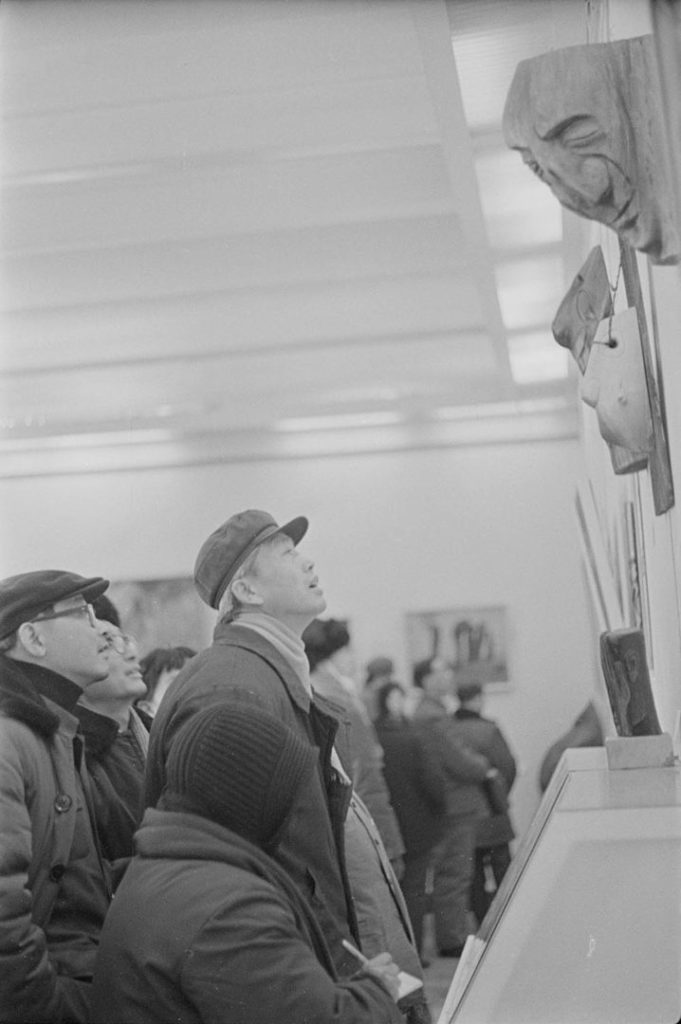
The Stars finally obtained the right to exhibit their works in an official venue, the Huafangzhai Gallery inside Beihai Park, from November 23 to December 2, 1979. The selection of works was essentially the same, except that seven new artists joined the Stars, including Ai Weiwei. The exhibition attracted 33,000 visitors, including several prominent figures from the cultural world. During the summer of 1980, the Stars were registered with the Beijing Artists Association. In August of the same year, the artists organized their second exhibition, this time inside the National Art Museum of China. In two weeks, 140,000 visitors flocked to see around one hundred works by the Stars, including Idol, a sculpture by Wang Keping depicting Mao as Buddha. Although for a few months the movement aroused as much interest from the public as from officials and personalities in the world of arts, the Stars suffered increasing political pressure, forcing them to dissolve the group and the exile of several members.
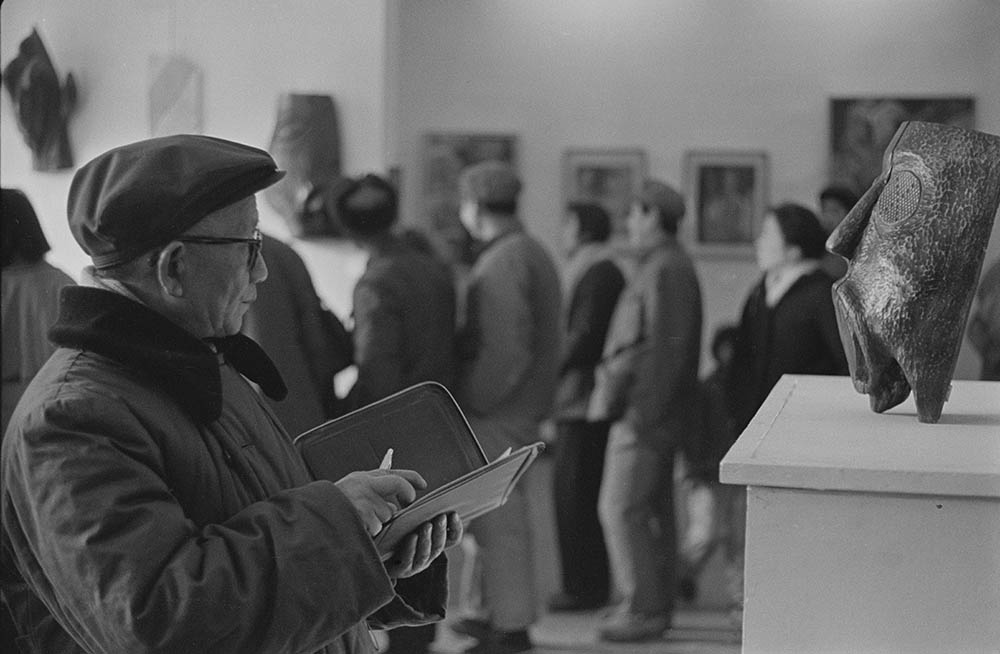
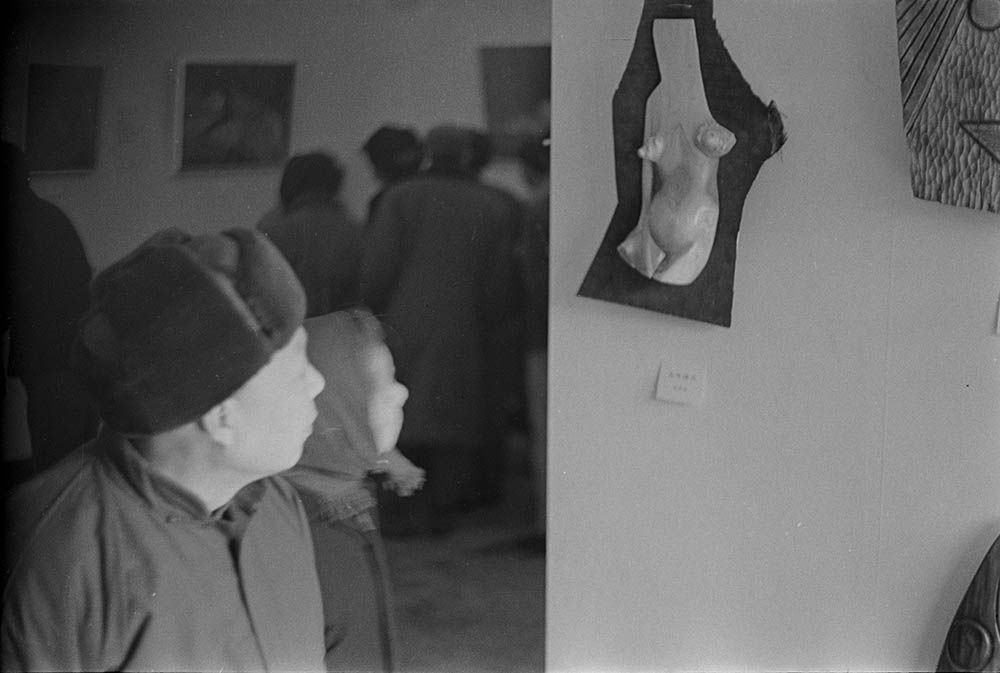
Chi Xiaoning, A visitor to the Stars exhibition at Huafangzhai Gallery in front of Wang Keping's sculpture Silence, November 1979
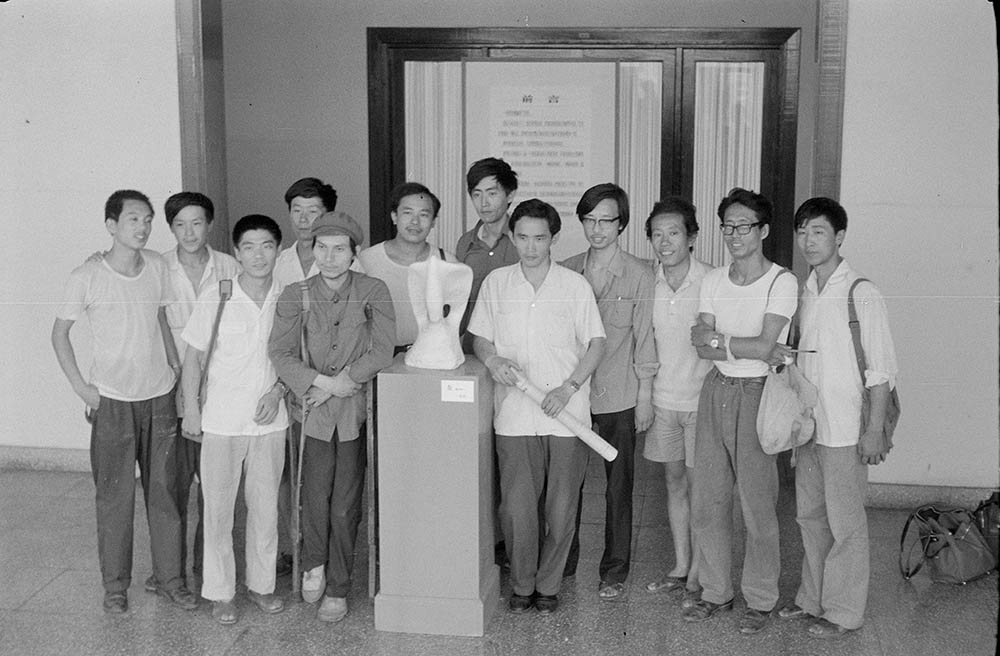
Chi Xiaoning, Group photo of the Stars and their friends at the2nd exhibition of the Stars at the China Fine Arts Museum, August 1980. From left to right: Shi Jinsheng, Chen Yansheng, Guo Xinyi, Qu Leilei, Ma Desheng, Wang Keping,...
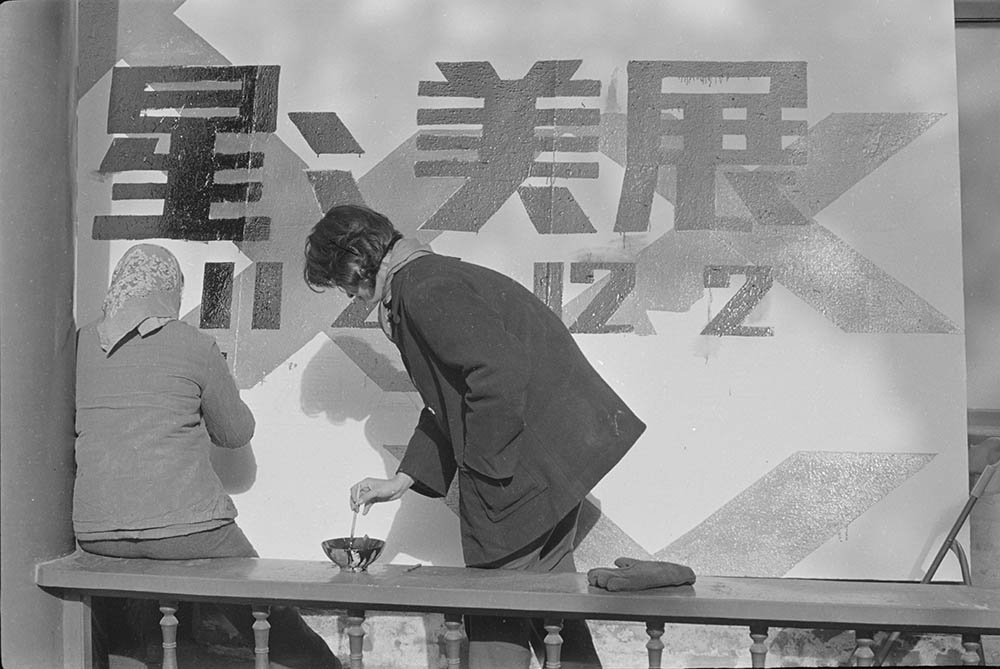
Chi Xiaoning, Artists Li Shuang and Shao Fei paint the poster for the Stars exhibition at the Huafangzhai Gallery, November 1979
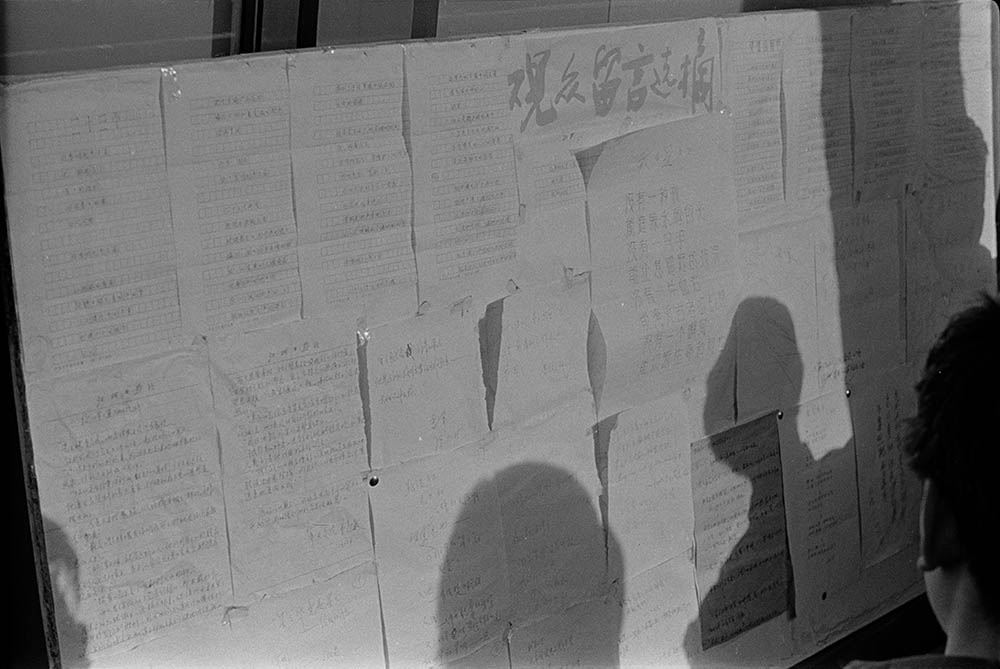
Chi Xiaoning, Comments from visitors to the Stars exhibition posted outside Huafangzhai Gallery, November 1979
Chi Xiaoning, Visitors to the Stars exhibition at Huafangzhai Gallery in front of Wang Keping sculptures, November 1979
Chi Xiaoning, Visitors to the Stars exhibition at the Huafangzhai Gallery in front of paintings by Guan Naixin, November 1979
Chi Xiaoning, Visitors to the Stars exhibition at the Huafangzhai Gallery in front of sculptures by Wang Keping, November 1979
Chi Xiaoning, A visitor to the Stars exhibition at Huafangzhai Gallery in front of Wang Keping's sculpture Silence, November 1979
Chi Xiaoning, Group photo of the Stars and their friends at the2nd exhibition of the Stars at the China Fine Arts Museum, August 1980. From left to right: Shi Jinsheng, Chen Yansheng, Guo Xinyi, Qu Leilei, Ma Desheng, Wang Keping, Bei Dao, Tan Yiping, Huang Rui, Liu Daxuan, Bao Pao, Zhu Jinshi
Chi Xiaoning, Artists Li Shuang and Shao Fei paint the poster for the Stars exhibition at the Huafangzhai Gallery, November 1979
Chi Xiaoning, Comments from visitors to the Stars exhibition posted outside Huafangzhai Gallery, November 1979
Chi Xiaoning, Visitors to the Stars exhibition at Huafangzhai Gallery in front of Wang Keping sculptures, November 1979
Chi Xiaoning, Visitors to the Stars exhibition at the Huafangzhai Gallery in front of paintings by Guan Naixin, November 1979
Chi Xiaoning, Visitors to the Stars exhibition at the Huafangzhai Gallery in front of sculptures by Wang Keping, November 1979
VI. 1980s: Dissolution of the Stars and legacy of the movement
In 1983, after the group’s dissolution, Huang Rui moved to Japan in 1984, where he expanded his artistic practice from painting to photography, installation, and performance. Also in 1984, Wang Keping moved to France, where his sculptures became less political and more refined. In 1985, Ma Desheng moved first to Switzerland, then, in 1986, to Paris. Li Shuang also settled in France in 1983. Four Stars emigrated to the United States: Ai Weiwei, the first to leave, in 1981; Yan Li in 1985; Zhong Ahcheng in 1987; and Shao Fei in 1988. Qu Leilei moved to England in 1986. Bo Yun decided to remain in Beijing, where he is now a professor at Tsinghua University and a painter. Yang Yiping also stayed in China. Mao Lizi divides his time between France and China. In recent decades, most of the still-active Stars have gone from being dissident and marginal artists to internationally renowned figures.
The short-lived Star movement marked the beginning of contemporary Chinese art through its members’ fierce determination to publicly exhibit works born from their “personal expression” and liberated from the Maoist ideology that had dominated Chinese society for 30 years. For the first time in China, unofficial artists exhibited within an institutional framework. The Stars paved the way for Chinese artists of the 1980s and 90s. In the 1980s, other artists in various cities and provinces across China also formed avant-garde art groups and experimented with forms and aesthetic concepts borrowed from the West. However, the triumph of the Stars was followed by a ten-year hiatus in the public exhibition of experimental art in official venues. This long period ended with a groundbreaking event, the “China/Avant-Garde” exhibition in 1989, also at the National Art Museum of China. The Stars’ bold move in 1979 paved the way for the development and recognition of contemporary Chinese art worldwide in recent decades.
Li Xiaobin, Party organized by the Stars at the Old Summer Palace (Yuanmingyuan), 1980
Chi Xiaoning, Wang Keping and his wooden sculpture Chaîne, 1979
Chi Xiaoning, Wang Keping and his wooden sculpture Chaîne, 1979
Li Xiaobin, Party organized by the Stars at the Old Summer Palace (Yuanmingyuan), 1980
Chi Xiaoning, Wang Keping and his wooden sculpture Chaîne, 1979
Chi Xiaoning, Wang Keping and his wooden sculpture Chaîne, 1979
VII. The echoes of the movement in France
A decade after May 1968 and the Maoist wave, interest in China remained strong in France. During the 1970s, filmmakers Joris Ivens and Marceline Loridan had filmed the Cultural Revolution (How Yukong Moved Mountains, 1976), and pro- and anti-Mao intellectuals clashed in the press—Simon Leys’s The Chairman’s New Clothes had already been published in 1971. The Beijing Spring was the subject of two important publications in 1980: a collection of dazibao (Chinese posters) compiled and translated by the enigmatic Victor Sidane (The Beijing Spring, Gallimard/Julliard), and texts by Chinese dissidents (A Bowl of Swallows’ Nests Does Not Make a Beijing Spring, C. Bourgois). In 1981, the arrest of Li Shuang (a Star artist in a relationship with a French diplomat) led to a demonstration and a petition signed by Simone de Beauvoir, Raymond Aron, Delphine Seyrig…
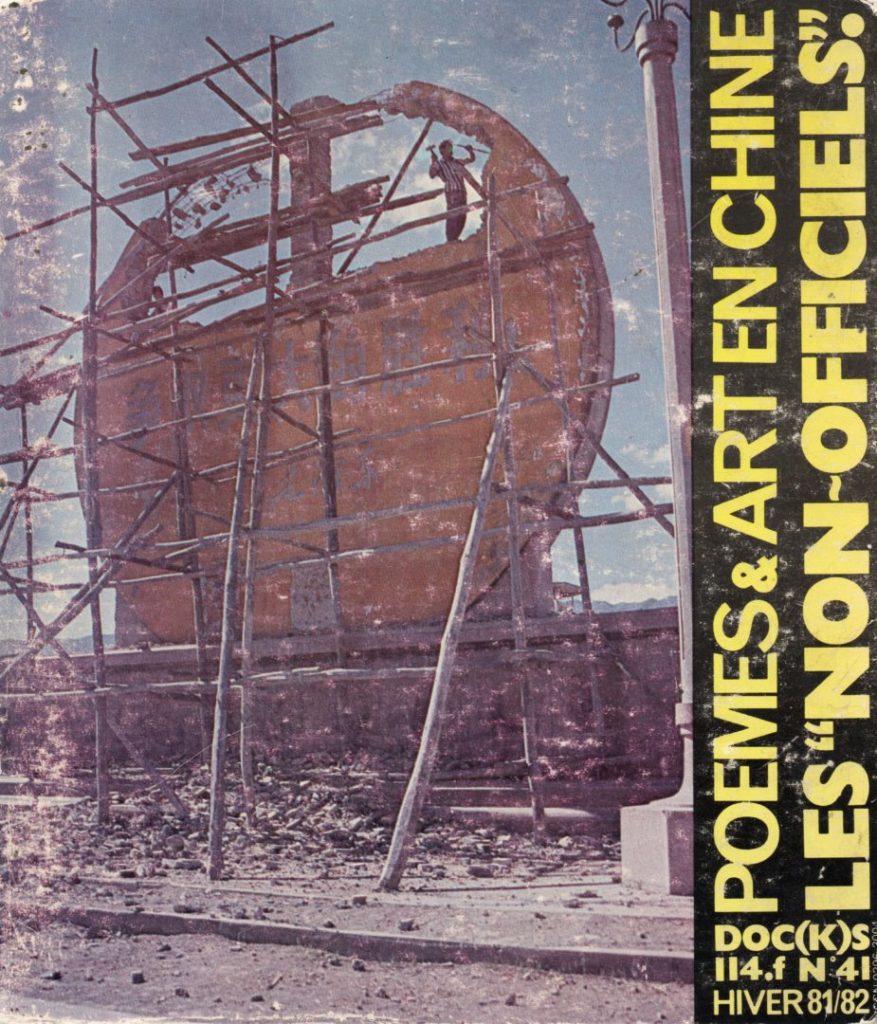
The first book on unofficial Chinese art was published in France in the winter of 1981/82: Poèmes & Art en Chine – Les « Non-Officiels » (Doc(k)s collection), by the poet Julien Blaine, who spent two months in Beijing meeting the Stars. It was one of the first books published in the West on the Chinese artistic and poetic avant-garde of the early 1980s.
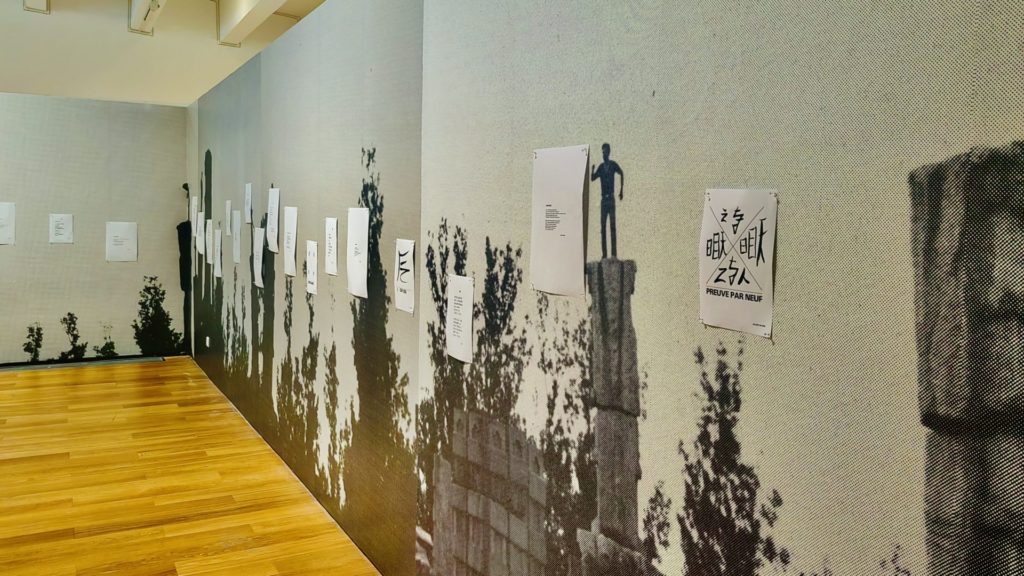
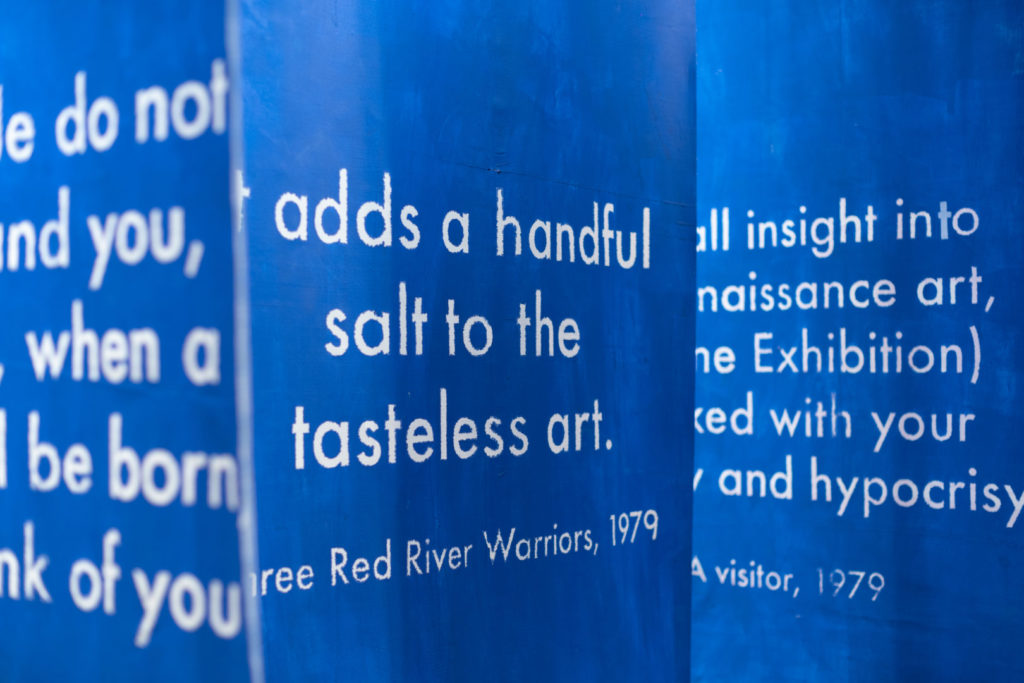
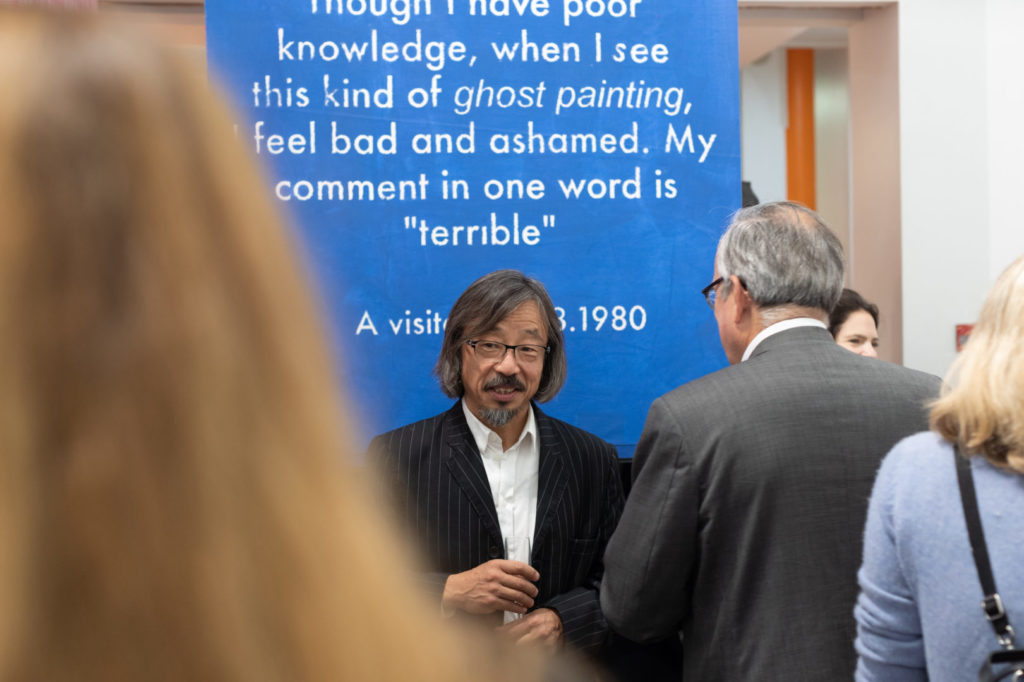
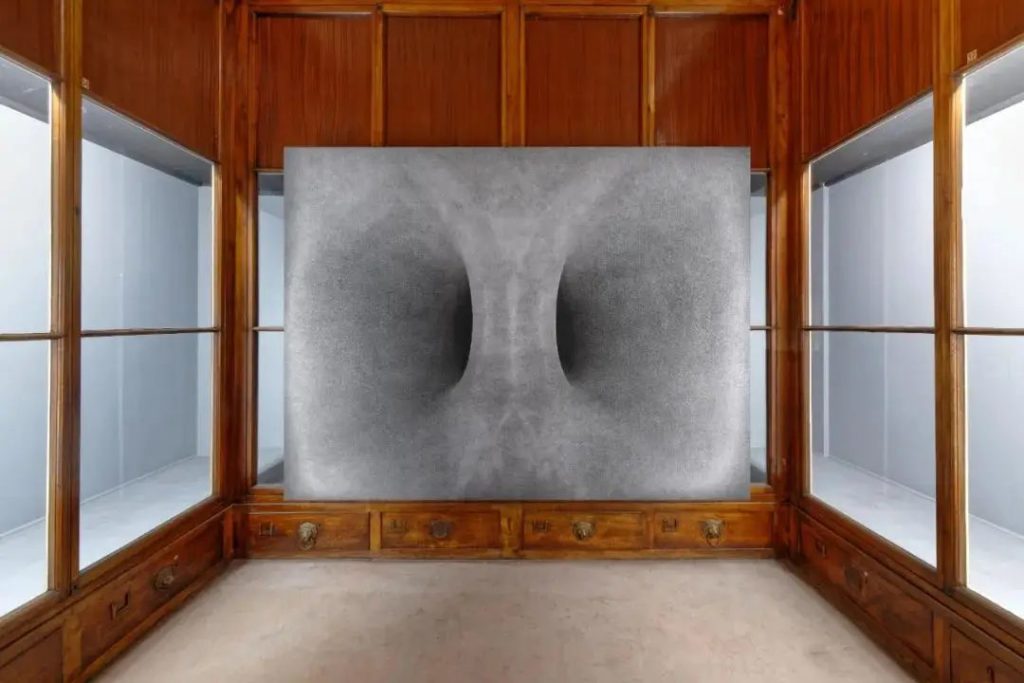
From September to November 2024, Victoria Jonathan presented an installation entitled Rebuilding Everything from a Shell at the Sichuan Fine Arts Institute in China, based on this book. Invited by curators Li Zhenhua and He Guiyan, the curator and director of the Doors agency has a personal connection to this journal and to Julien Blaine’s time in China: her own father, Philippe Jonathan, an architect and expert on China, accompanied the poet during his stay, participated in organizing the First International Poetry Meeting at Yuan Ming Yuan (Old Summer Palace) in 1981, and even signed several of the poems in the book under the pseudonym Ferdinand Godard.
This installation was part of the group exhibition “We will meet again again again,” curated by Li Zhenhua and He Guiyan, and aimed to trace individual artistic trajectories between France and China. The exhibition was part of the 2024 celebrations marking the 60th anniversary of diplomatic and cultural relations between France and China.
DOC(K)S magazine coverView of the exhibition «Rebuilding everything from a shell», 2024
The works of Huang Rui, Ma Desheng and Wang Keping
In addition to photographs that trace the main events in the history of the Stars movement, the exhibition “The Stars, 1979-2019, Pioneers of Contemporary Art in China” featured paintings, engravings, sculptures and installations created by the three founding artists of the movement: Huang Rui, Ma Desheng and Wang Keping.
The Star Flags, by Huang Rui
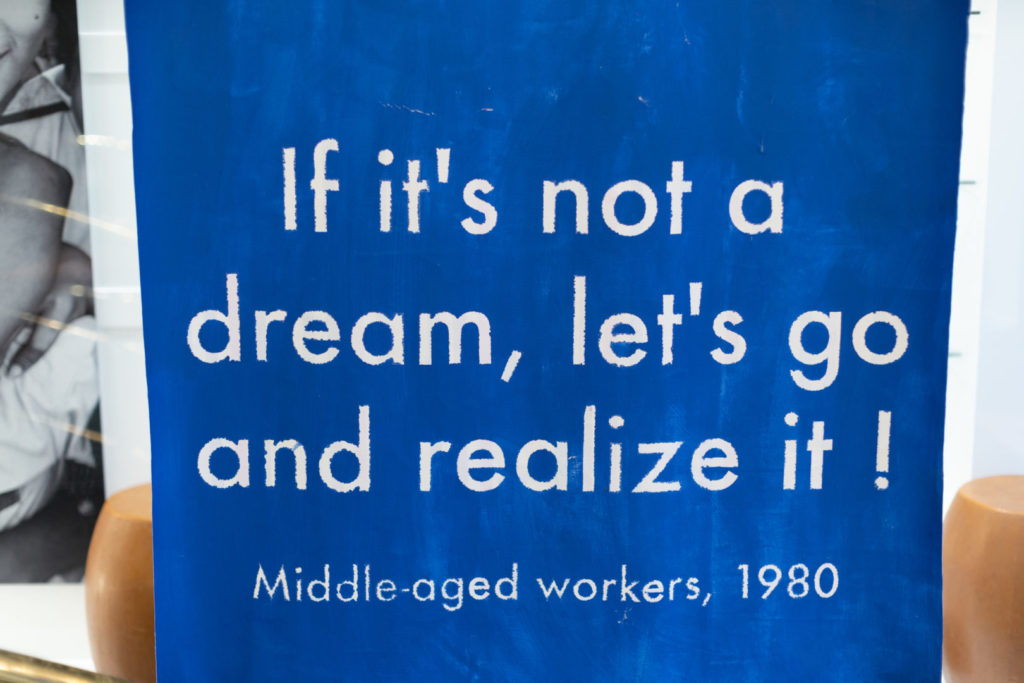
Having spent part of his youth as a peasant laborer in Inner Mongolia as part of the Educated Youth Campaign, Huang Rui is a self-taught artist. A co-founder of the magazine Today in 1978 and then of the Stars movement in 1979, he went into exile in Japan in 1984. Returning to Beijing in 2000, he became one of the key figures in the 798 art district. Huang Rui expresses himself through painting, installation, and performance. His early works were inspired by modern Western painting (Expressionism, Fauvism, and Cubism). Gradually, his style became more defined, and he became a leading figure in abstract and conceptual art in China. His work explores contemporary issues, such as urban transformations and the hypocrisy of political regimes, while drawing inspiration from the Book of Changes and the philosophy of Yin and Yang. For this exhibition, he created Stars Flags, a work paying homage to the stars, which reaffirms that art is above all free and independent. Huang Rui’s works are part of the collections of the Guggenheim Museum (New York), the National Art Museum of China, and the M+ Museum (Hong Kong), among others.
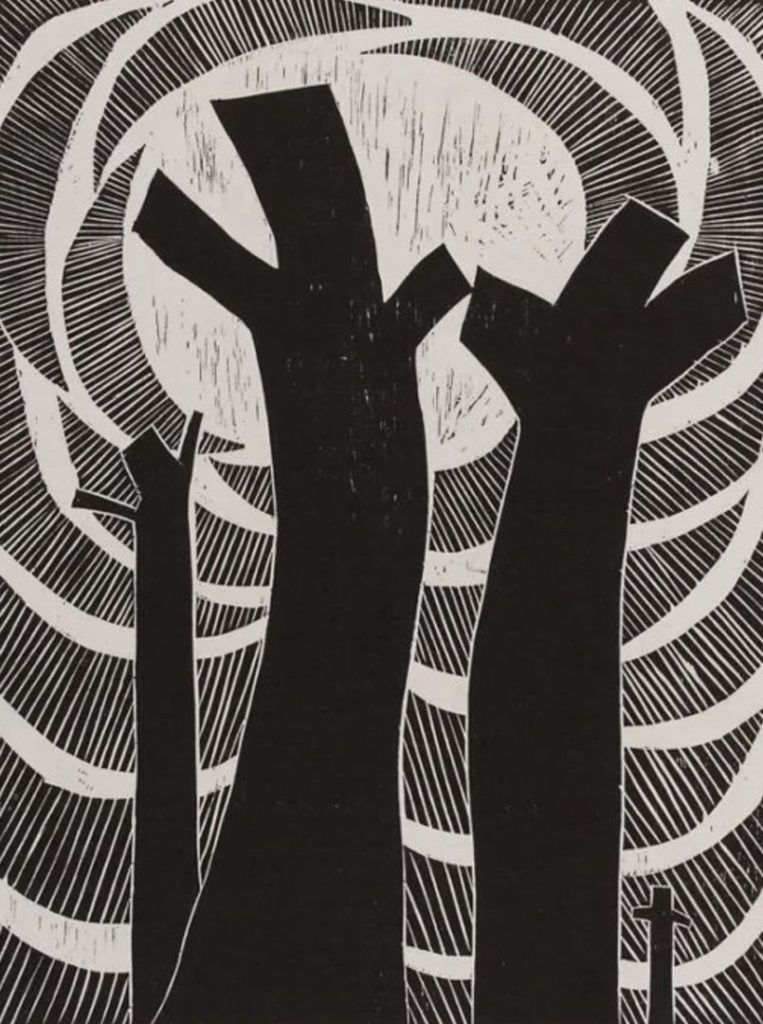
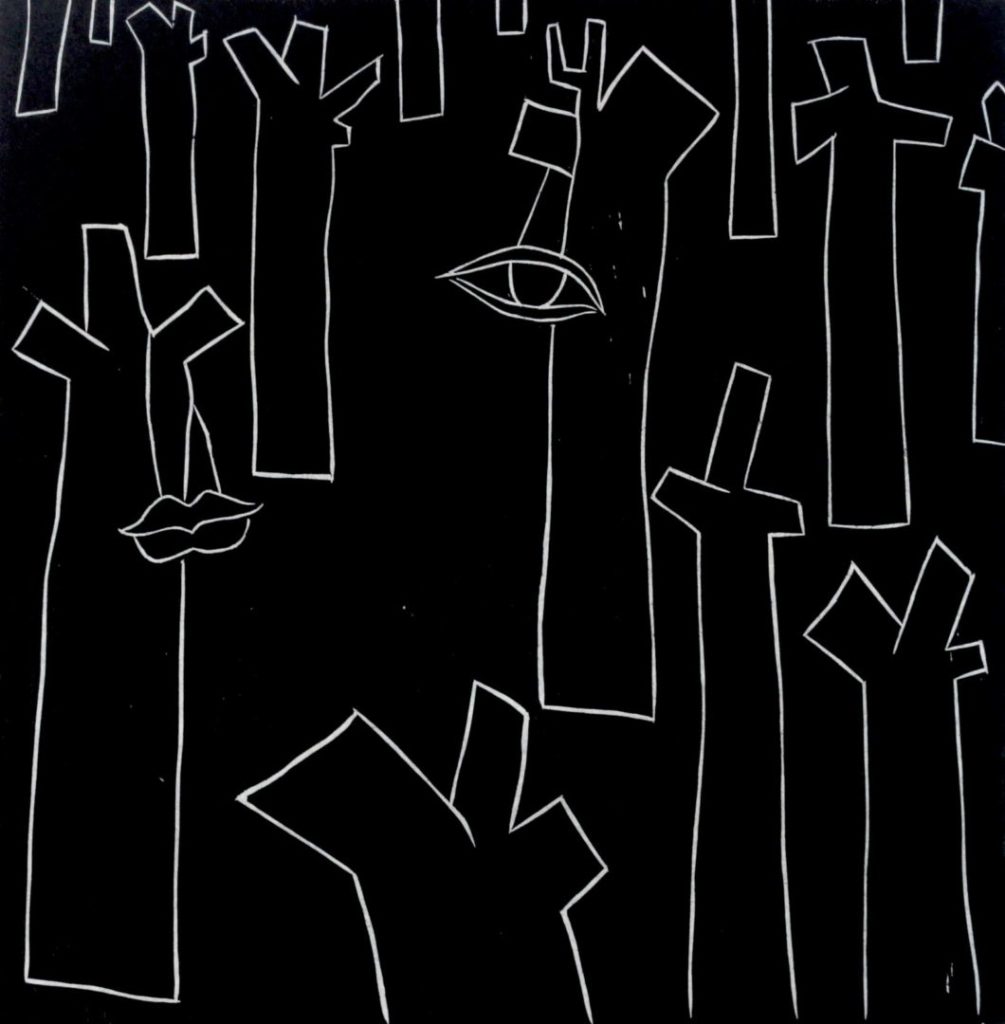
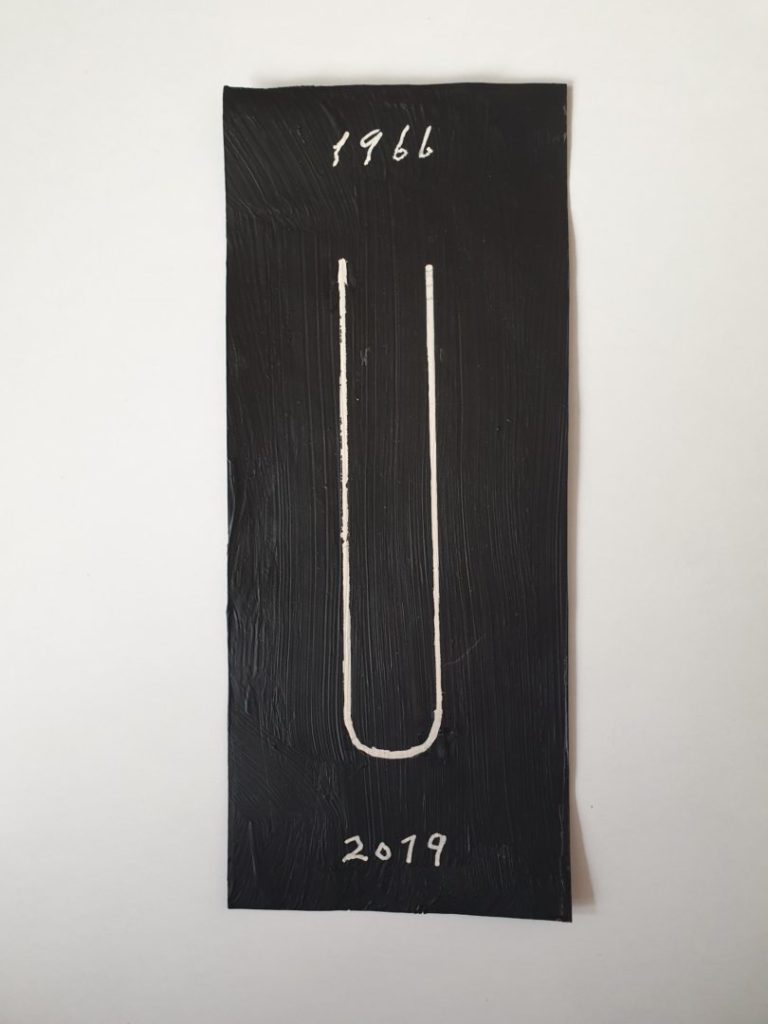
Poet, engraver, calligrapher, painter, and performance artist, Ma Desheng has lived in Paris since 1985. Co-founder of the journal Today and the Stars collective, he is a fervent advocate for freedom of expression. A self-taught artist, he began his career as an industrial draftsman in a factory by day, while dedicating himself to engraving and poetry by night. After a car accident that left him paralyzed in 1992, Ma was forced to abandon engraving and ink painting. Today, he works with acrylics, a technique that allows him a speed and spontaneity of execution akin to ink, to paint his favorite subjects: the female body and stones. His work has been featured in international exhibitions and art fairs. Her works are included in the collections of the National Museum of Modern Art (Centre Pompidou), the British Museum, the Fukuoka City Museum, the Museum of Modern Art of the City of Paris, the Cernuschi Museum (Paris), and the M+ Museum (Hong Kong). Recent exhibitions (2019) include a retrospective at the Domaine départemental de Chamarande, an exhibition of her sculptures at the Domaine de Chaumont-sur-Loire, and an open-air sculpture at Frieze Sculpture (London).
Ma Desheng, Untitled, 1980. Wood engraving. 50x45cm with frames
Ma Desheng, Untitled, 1980. Wood engraving. 50x45cm with frames
Ma Desheng, Untitled, 2019. Acrylic paint on canvas. 300x120cm
The sculptures of Wang Keping
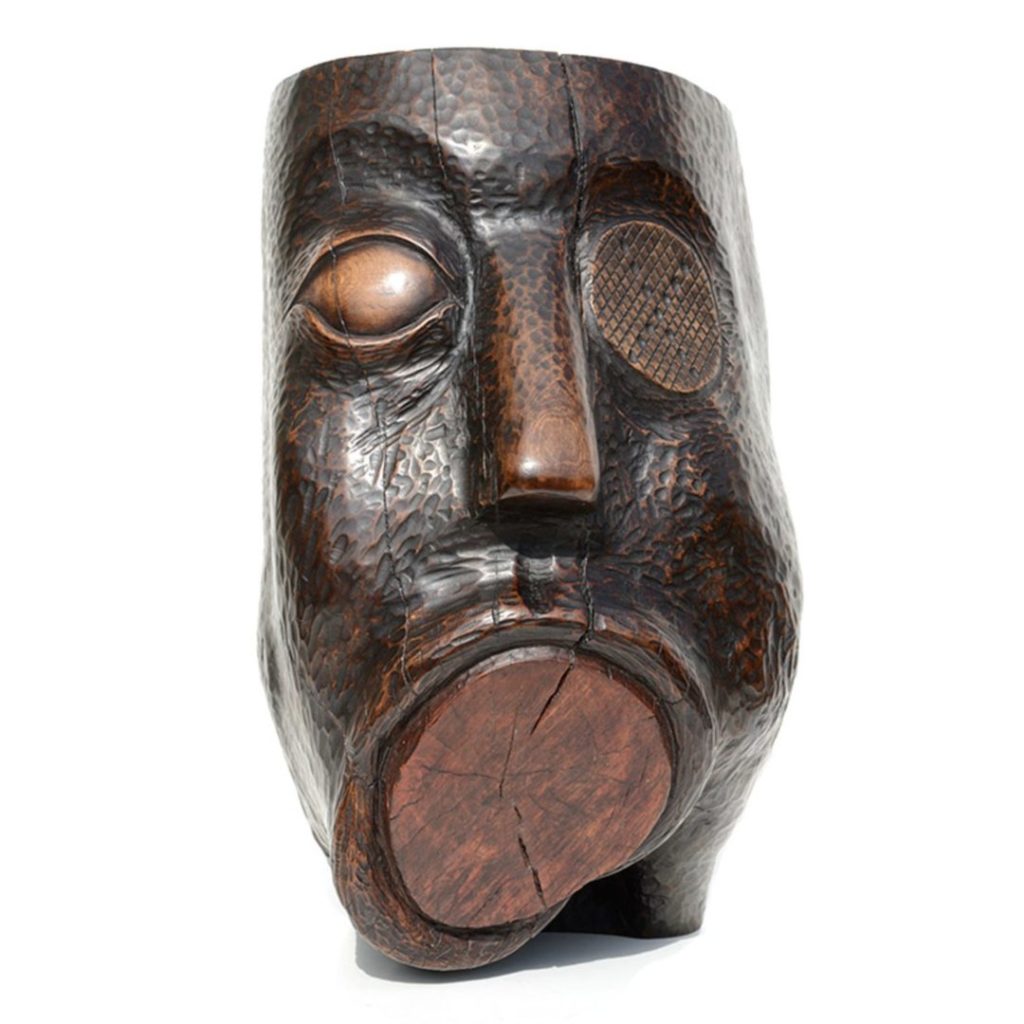
Wang Keping began sculpting wood as a self-taught artist in the late 1970s, after having been, during the Cultural Revolution, successively a peasant, a factory worker, and then an actor and screenwriter for national television. During the Beijing Spring, he participated in the Democracy Wall and became an active member of the Stars movement in 1979. He hung his manifesto sculpture, Silence, on the railings of the Beijing Museum of Fine Arts—a face/mask with its right eye closed and mouth covered—to express the lack of freedom of expression and the prevailing censorship. Exiled to France in 1984, Wang Keping abandoned political themes in favor of depicting female bodies or embracing couples. Using fallen tree trunks from the forest or branches brought back to his studio, he works with a chainsaw, blowtorch, and chisel. His internationally recognized work is preserved in the greatest museums: Centre Pompidou, Musée Guimet or He Xiangning Museum (Shenzhen).
«Silence», 1978, Wood carving, H 43 x 27 x 27 cm
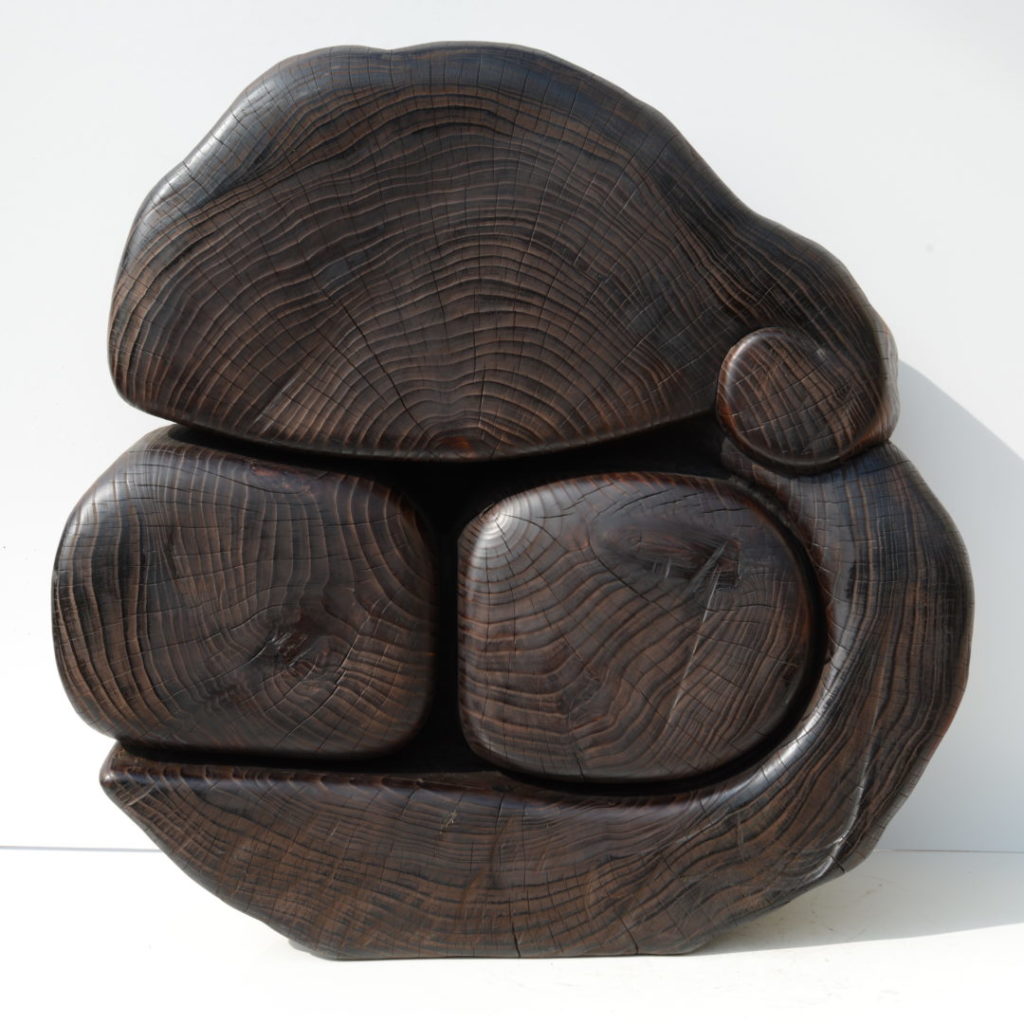
Wang Keping, Moon Fairy, 2010. Wood sculpture. 78x79x23cm
Seven Chinese artists of the new generation spoke about navigating between two cultures, their reflections on identity—between China and the West—their academic paths, and the ways in which these experiences nourish and transform their artistic practice, with a constant spirit of lucidity and critical awareness.
This interview explores the transdisciplinary approach of art historian Estelle Zhong Mengual, who connects art history, ecology, anthropology, and philosophy to rethink our relationship with living beings. Through painting, dance, and literature, she proposes new forms of attention and aesthetics in the face of the ecological crisis.
ArtistsZhuang Hui, Chen Qiulin, Michael Cherney, Sui Taca, Cheng Xinhao
CuratorVictoria Jonathan
We use cookies on our website to give you the most relevant experience by remembering your preferences and repeat visits. By clicking “Accept All”, you consent to the use of ALL the cookies. However, you may visit "Cookie Settings" to provide a controlled consent.
This website uses cookies to improve your experience while you navigate through the website. Out of these, the cookies that are categorized as necessary are stored on your browser as they are essential for the working of basic functionalities of the website. We also use third-party cookies that help us analyze and understand how you use this website. These cookies will be stored in your browser only with your consent. You also have the option to opt-out of these cookies. But opting out of some of these cookies may affect your browsing experience.
Necessary cookies are absolutely essential for the website to function properly. These cookies ensure basic functionalities and security features of the website, anonymously.
Cookie
Duration
Description
cookielawinfo-checkbox-analytics
11 months
This cookie is set by GDPR Cookie Consent plugin. The cookie is used to store the user consent for the cookies in the category "Analytics".
cookielawinfo-checkbox-functional
11 months
The cookie is set by GDPR cookie consent to record the user consent for the cookies in the category "Functional".
cookielawinfo-checkbox-necessary
11 months
This cookie is set by GDPR Cookie Consent plugin. The cookies is used to store the user consent for the cookies in the category "Necessary".
cookielawinfo-checkbox-others
11 months
This cookie is set by GDPR Cookie Consent plugin. The cookie is used to store the user consent for the cookies in the category "Other.
cookielawinfo-checkbox-performance
11 months
This cookie is set by GDPR Cookie Consent plugin. The cookie is used to store the user consent for the cookies in the category "Performance".
viewed_cookie_policy
11 months
The cookie is set by the GDPR Cookie Consent plugin and is used to store whether or not user has consented to the use of cookies. It does not store any personal data.
Functional cookies help to perform certain functionalities like sharing the content of the website on social media platforms, collect feedbacks, and other third-party features.
Performance cookies are used to understand and analyze the key performance indexes of the website which helps in delivering a better user experience for the visitors.
Analytical cookies are used to understand how visitors interact with the website. These cookies help provide information on metrics the number of visitors, bounce rate, traffic source, etc.
Advertisement cookies are used to provide visitors with relevant ads and marketing campaigns. These cookies track visitors across websites and collect information to provide customized ads.