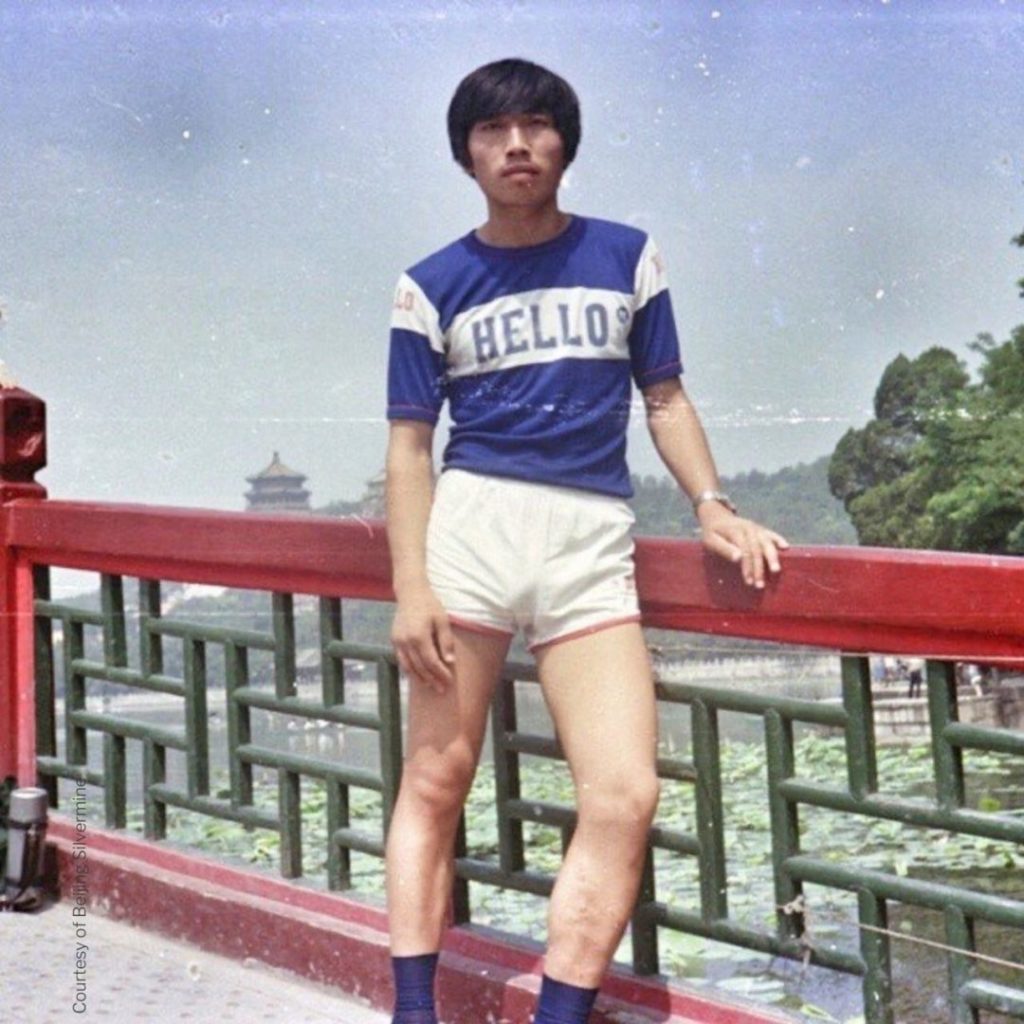
Liu Ke: “I wanted […] to feel the movement of deep currents beneath the calm waters of the river.”
Liu Ke was born in 1977 in Chengdu, where he still lives today. He works as a duo with his partner, Huang Huang.
In 2019, they won the Three Shadows Photography Award—one of the most prestigious photography prizes in China—for their series Mirror. They have participated in numerous exhibitions in China (CAFA Museum, Jimei x Arles, Dali International Festival, Lianzhou Foto Festival, etc.) and in Japan. Between 2007 and 2009, Liu Ke carried out the solo project Still Lake, retracing his paternal family’s roots in the Three Gorges region. The series earned him a nomination for the Dutch FOAM Paul Huf Award.
DoorZine: Still Lake is a series of 113 photographs taken between 2007 and 2009 along the banks of the Three Gorges Dam, which you explored over a period of three years. You are from Chengdu, a city close to the dam, yet you had never visited the site before this project. It was in 2007, after the death of your grandmother, that you traveled there for the first time to the Three Gorges, where your family originates. This was at the end of the dam’s construction. Can we say that this photographic project is as personal as it is documentary?
Liu Ke: My family comes from a small village on the banks of the Yangtze River, Baisha (near Chongqing). I grew up in Chengdu, where I spent most of my life. Although my father often told me stories about that place, the Three Gorges and the Yangtze were foreign to me. Around the age of ten, my father left his hometown to attend school in Wuhan. He left alone by boat, traveling down the river and leaving the Three Gorges behind. For him, the Three Gorges represented a gateway to the outside world. Since childhood, I have admired my father. I turned my early practice of painting and photography into my profession. Before Still Lake, I mainly worked in commercial photography. The artistic quest had gradually turned into an effort to satisfy clients. I like to be alone, but in advertising we worked in teams. I wasn’t very happy.
In 2007, my grandmother was hospitalized. In the days before her death, she was in a state of deep confusion. A continuous stream of words poured from her mouth, without logic—like a spectator reviewing her own life. For several days, I stayed by her side, and I began to question, in a very acute way, the meaning of existence. Is life simply the accumulation of daily routines, day after day? After that experience, I felt even more unhappy. Huang Huang, my partner, suggested that we take a trip, and I chose to go to the Three Gorges. This was after the major media frenzy around the project had faded, and Chinese society had lost interest. The great dam had been built. What needed to be destroyed, relocated, submerged… the displaced populations… all of that had already happened.
Everything felt as if calm had returned. It was my existential questioning that led me to pick up my camera and turn it toward these people and this land that were unfamiliar to me. I wanted to begin with these people, whose existence is as small and ordinary as mine, and, starting from fragmented visual impressions, to experience solitude and perseverance, to feel the movement of deep currents beneath the calm waters of the river. Three years is not long in the span of a human life. But this project became a part of my life.
DoorZine:You photograph many landscapes of the Three Gorges—the river and the mountains are omnipresent in your images—yet it seems that people are the true landscape you are photographing, whether they appear as tiny points lost in vastness or are captured in close-up. Is Still Lake above all a series of portraits?
Liu Ke: The external environment and landscape have an obvious influence on the human heart, just as much as social and historical contexts. The shooting distance corresponds both to the distance I happened to take in my encounters with these subjects and places, and to the distance between my heart and reality at that moment. Nothing was meticulously planned.
Encounters that occurred by chance seemed to form a mysterious connection with me, striking me at the core and pushing me to press the shutter. I am fascinated by those feelings that manifest themselves in reality but cannot be explained with words. When I photograph a subject, I am also looking at myself. Nothing is certain. These photographs can therefore be seen as individual portraits—or as portraits of my heart at that precise moment.
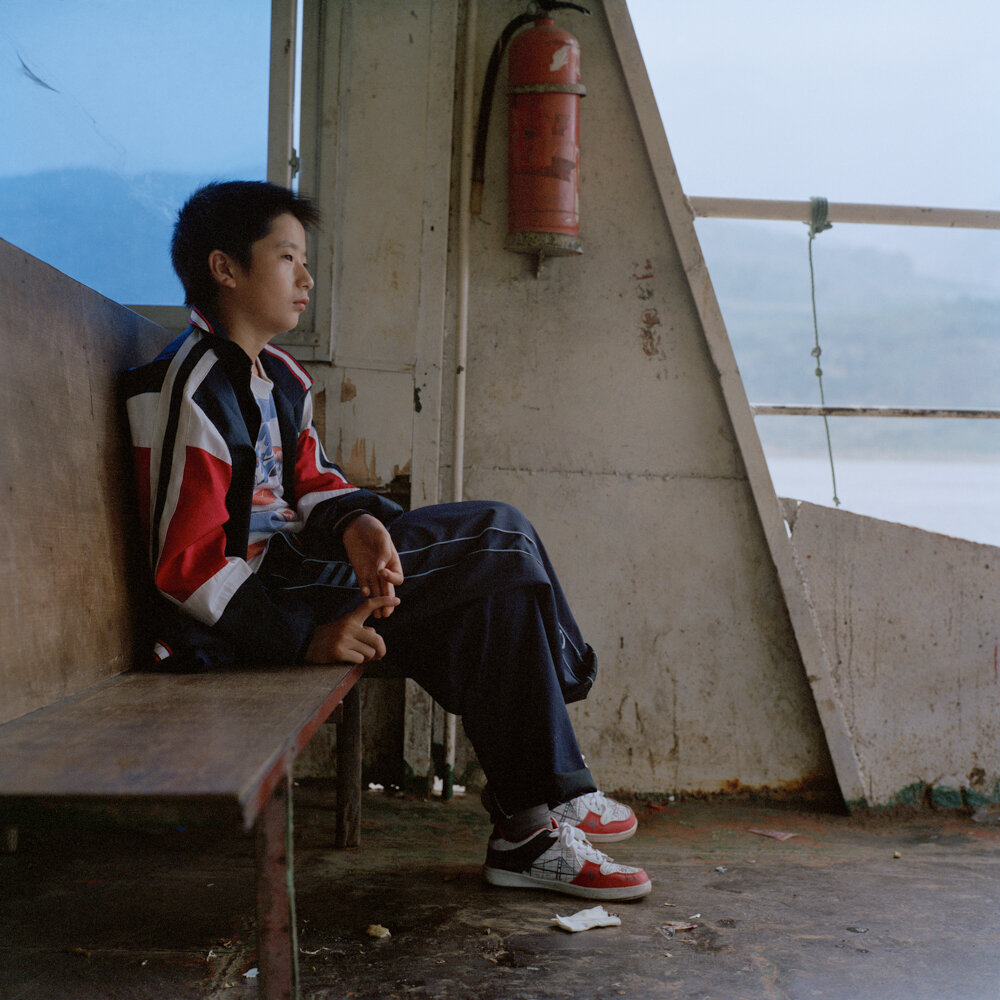
Liu Ke, “Boy on Ferry”, 2008. From the series “Still Lake” (2007-2009). Courtesy of the artist.
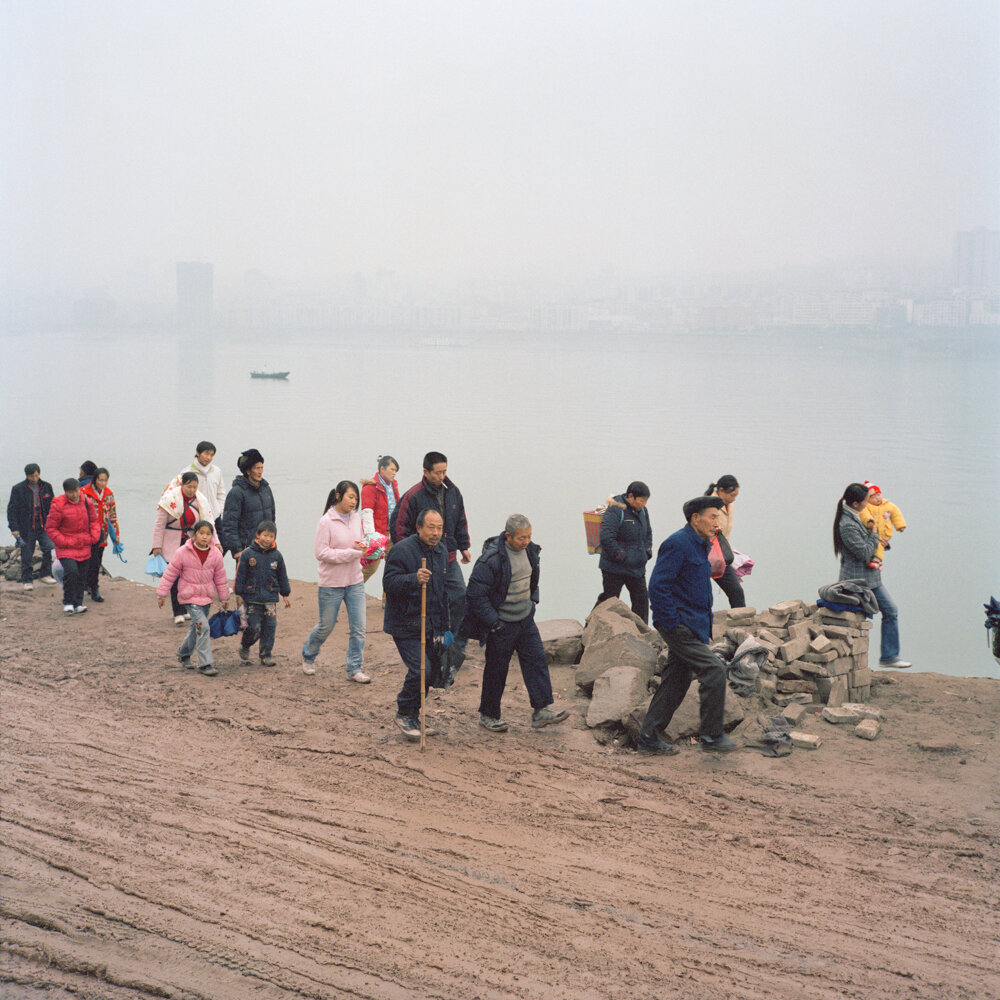
Liu Ke, “Moving Forward”, 2009. From the series “Still Lake” (2008-2009).
DoorZine: In the foreword to your book Still Lake (published in 2019 by Three Shadows Editions), you refer to the rich tradition of scholars, poets, and artists inspired by the Three Gorges, a place where “danger and beauty” intertwine. What role did Chinese poetry and painting play in your approach to this subject? Were there other influences, particularly photographic ones?
Harmony between heaven and humanity represents the highest stage of traditional Chinese culture. Emotion, sorrow, solitude—the exploration of existence by the Ancients was often expressed through their feelings toward mountains and rivers. From antiquity to the present day, the Three Gorges have deeply inspired Chinese literati, leaving behind countless works. In China, we learn poems and historical stories related to the Three Gorges from a very young age. It was only when I went there that I truly understood the significance of the Yangtze River and the Three Gorges for the local population. The river not only allows people to live, but also nourishes their hopes and dreams. At the end of the book, I wrote the sentence: “the water of the river always flows,” because I believe that flow is at the heart of life, and I hope that each image contains within it the current of an unknown emotion. During the three years of Still Lake, I was often on the road.
The book I read the most was the Zhuangzi*. I love the freedom and lightness of its spiritual world, where even lost and solitary people possess poetic beauty. For three years, I strove to achieve a fluid expression, created in a single breath, directly from the heart. I chose the 6×6 square format for the freedom and naturalness it allowed me. In my photographs, I seek to express the beauty of nature and reality in the most spontaneous and immediate way. The art book I consulted the most was about Liu Xiaodong. I also read Kerouac’s On the Road extensively. To be honest, I don’t look much at other photographic work when I’m working on a project. The development of strong work is spiritual, not merely formal.
DoorZine: The title of your series Still Lake comes from a poem by Mao Zedong. Why this reference?
At first, I wanted to call the project “Deep Currents.” Once, I took a small boat to cross the river. The person steering the boat told me: don’t be fooled by these peaceful waters—in reality they are crossed by deep currents beneath the surface. That sentence deeply moved me. Those deep currents are what I wanted to express in my work:
Later, while researching the Three Gorges, I came across Mao Zedong’s 1956 poem Swimming, written in Wuhan, in which he writes:
“Stone walls upstream will stand To hold back Wushan**’s clouds and rain; In the steep gorge a still lake will rise.”***
This last line was seen as a premonition of the Three Gorges Dam project. “A still lake”: a somewhat pale expression, even a romantic aspiration—yet these words propelled the Three Gorges into a new era.
“A still lake,” calm like these photographs, like life itself—but behind the calm lie deep and unknown realities waiting to be discovered. That is why I ultimately chose the title Still Lake, which holds more uncertain meanings.
Hand-written version of Mao Zedong’s poem «The Swim» (1956)
DoorZine: Critic Gu Zheng writes in his preface to your book about the mixture of strangeness and banality conveyed by your photographs. He states: “This is a new kind of documentary photography focused on non-events.”**** What do you think of that?
Gu Zheng was a member of the Three Shadows Award jury when I first participated in 2009 with Still Lake. He also included works from this series in several group exhibitions. Ten years ago, Gu already spoke about the construction of a personal visual expression of individual experience in my work—about using photography as a means to explore cognitive boundaries and the spiritual world of individuals, to stimulate inner reflection and dialogue. Ten years later, in the preface to Still Lake, Gu proposes a distinction between “the strange” and “the ordinary.” That is exactly how I conceive my work. It is not the captured event itself that inspires me, but the mysterious breath that reacts to the external environment.
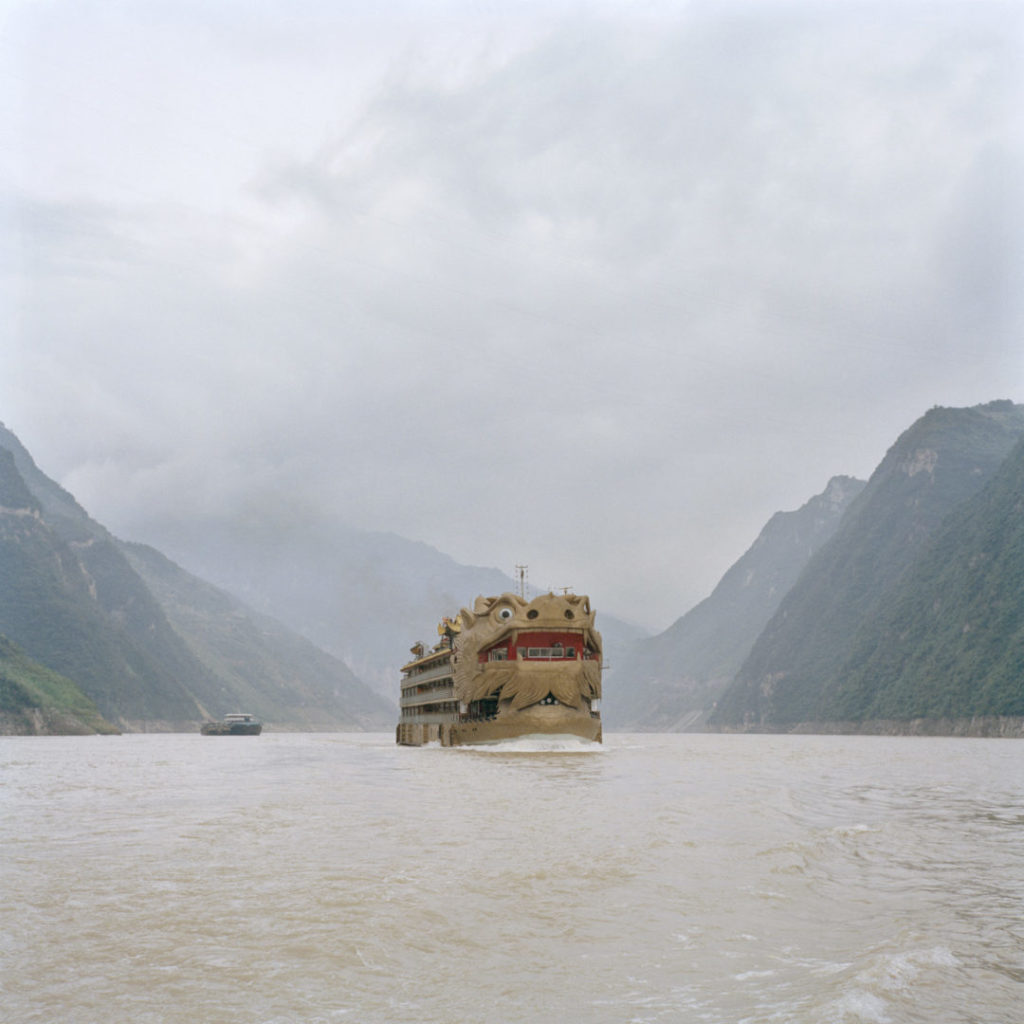
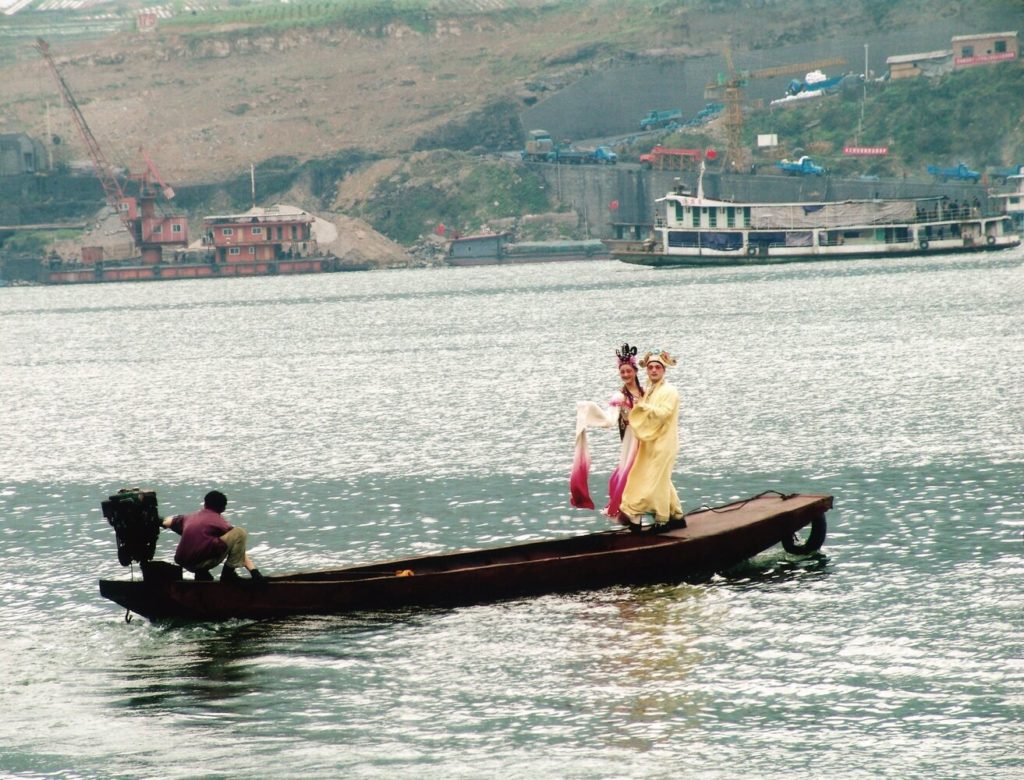
Liu Ke, “The Dragon Ship”, 2008. From the series”Still Lake”. Courtesy of the artist.
*Foundational text of Taoism, named after its author, the philosopher Zhuang Zi (4th century BCE).
**Wushan: A mountain located southeast of the district of the same name in Sichuan, where, according to legend, a goddess resides who controls the clouds and the rain.
***Translation by Ho Ju, published by Foreign Languages Press, Beijing. Mao regarded swimming as the best of sports and as a symbol of human strength confronting nature—those same human forces that built bridges across the Yangtze and that he already envisioned undertaking the construction of the Three Gorges Dam.
The man confronting nature was also Mao himself ten years later, in 1966: at the age of 73, he swam more than 10 kilometers in the river at Wuhan. He was said to be politically weakened, and rumors claimed he was gravely ill, if not already dead. Mao demonstrated that he was still keeping his head above water and went on to launch the Cultural Revolution.
****Gu Zheng, “Interweaving the Strange and the Ordinary: Liu Ke’s Human Landscapes of the Three Gorges,” Still Lake, Three Shadows Photography Art Centre, 2019. Available on the artist’s website: here.
Interview conducted by Victoria Jonathan & Bérénice Angremy.
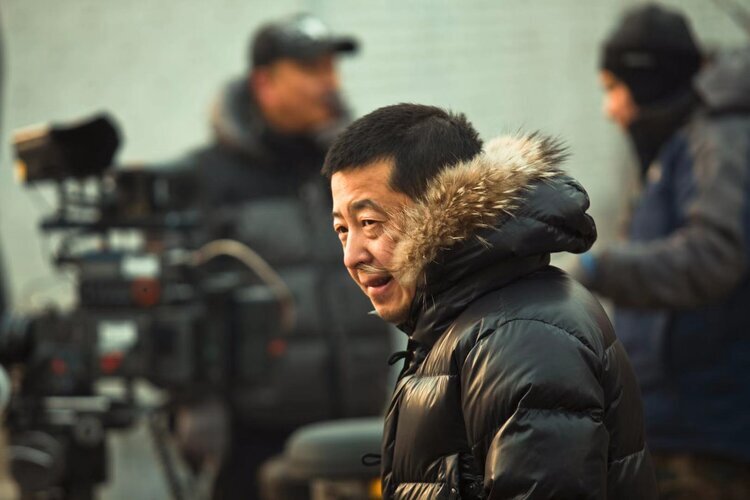
Considered one of China's greatest directors, Jia Zhangke develops a cinema rooted in the realities of contemporary China. Doors exhibited excerpts from his films set in the Three Gorges region to explore the filmmaker's connection to the Chinese landscape.
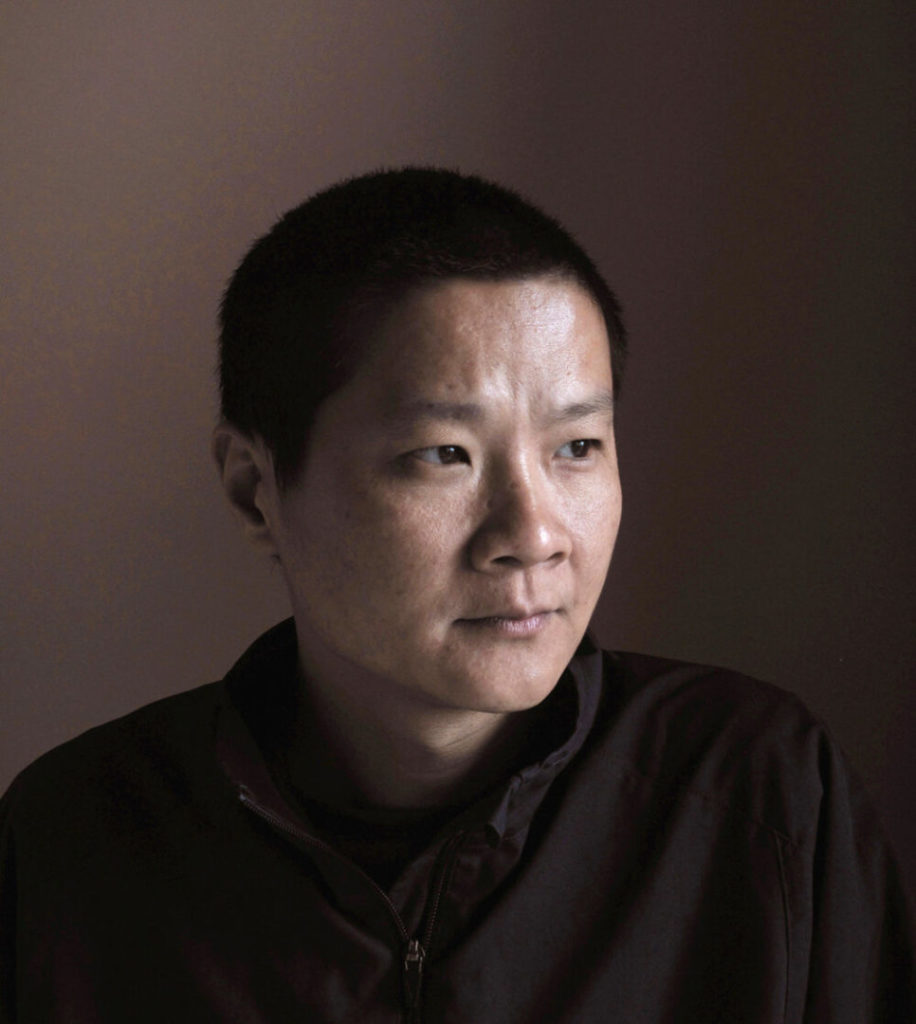
After years working as a press photographer, Luo Dan traveled across China from east to west, photographing people and landscapes. From 2010 to 2012, he lived in a remote valley in Yunnan within a community whose way of life has remained almost unchanged for a hundred years, and revived a forgotten photographic process: wet plate collodion.
artistsYang Yongliang, Sui Taca, Luo Dan, Michael Cherney, Edward Burtynsky, Zhuang Hui, Chen Qiulin, Mu Ge, Liu Ke, Jia Zhangke, Zhang Xiao, Chen Ronghui, Zhang Kechun.
curatorsVictoria Jonathan, Bérénice Angremy
We use cookies on our website to give you the most relevant experience by remembering your preferences and repeat visits. By clicking “Accept All”, you consent to the use of ALL the cookies. However, you may visit "Cookie Settings" to provide a controlled consent.
This website uses cookies to improve your experience while you navigate through the website. Out of these, the cookies that are categorized as necessary are stored on your browser as they are essential for the working of basic functionalities of the website. We also use third-party cookies that help us analyze and understand how you use this website. These cookies will be stored in your browser only with your consent. You also have the option to opt-out of these cookies. But opting out of some of these cookies may affect your browsing experience.
Necessary cookies are absolutely essential for the website to function properly. These cookies ensure basic functionalities and security features of the website, anonymously.
Cookie
Duration
Description
cookielawinfo-checkbox-analytics
11 months
This cookie is set by GDPR Cookie Consent plugin. The cookie is used to store the user consent for the cookies in the category "Analytics".
cookielawinfo-checkbox-functional
11 months
The cookie is set by GDPR cookie consent to record the user consent for the cookies in the category "Functional".
cookielawinfo-checkbox-necessary
11 months
This cookie is set by GDPR Cookie Consent plugin. The cookies is used to store the user consent for the cookies in the category "Necessary".
cookielawinfo-checkbox-others
11 months
This cookie is set by GDPR Cookie Consent plugin. The cookie is used to store the user consent for the cookies in the category "Other.
cookielawinfo-checkbox-performance
11 months
This cookie is set by GDPR Cookie Consent plugin. The cookie is used to store the user consent for the cookies in the category "Performance".
viewed_cookie_policy
11 months
The cookie is set by the GDPR Cookie Consent plugin and is used to store whether or not user has consented to the use of cookies. It does not store any personal data.
Functional cookies help to perform certain functionalities like sharing the content of the website on social media platforms, collect feedbacks, and other third-party features.
Performance cookies are used to understand and analyze the key performance indexes of the website which helps in delivering a better user experience for the visitors.
Analytical cookies are used to understand how visitors interact with the website. These cookies help provide information on metrics the number of visitors, bounce rate, traffic source, etc.
Advertisement cookies are used to provide visitors with relevant ads and marketing campaigns. These cookies track visitors across websites and collect information to provide customized ads.